
8 Ways to Use Retinol for Better Results
Table of Contents
- Start With Clean, Dry Skin
- Use a Pea-Sized Amount
- Master the Retinol Sandwich Method
- How to Layer Retinol With Other Serums
- How Often to Use Retinol for Beginners
- Apply SPF Every Morning
- Manage Skin Irritation and Purging
- Frequently Asked Questions
Last Updated: October 3, 2026
Start With Clean, Dry Skin
Clean, dry skin is essential when you use retinol for better results. Residual moisture, oils, or debris prevent proper penetration and increase irritation.
Cleanse with a gentle cleanser, then wait 15-20 minutes before applying retinol. Damp skin traps the product at the surface, amplifying irritation without improving efficacy.
Pat your face dry with a clean towel rather than rubbing, which can irritate skin and create micro-tears. Aim for a completely dry canvas.
Use a Pea-Sized Amount
A pea-sized amount is the standard recommendation for facial application when you use retinol for better results.
More product does not equal faster results. Excess retinol increases irritation and flaking without improving efficacy, as your skin can only process so much retinoid at once.
A pea-sized amount covers your entire face. Dispense onto your fingertip or palm, warm slightly between your hands, and press gently into your skin rather than rubbing.
Start conservatively; you can increase as your skin adapts. Most people see results within 4-6 weeks of consistent use.
Master the Retinol Sandwich Method
The retinol sandwich method protects your skin barrier while allowing the retinoid to work effectively when you use retinol for better results.
Apply a lightweight moisturizer first, then your pea-sized retinol serum, then another layer of moisturizer. This reduces irritation by buffering the retinoid while allowing penetration.
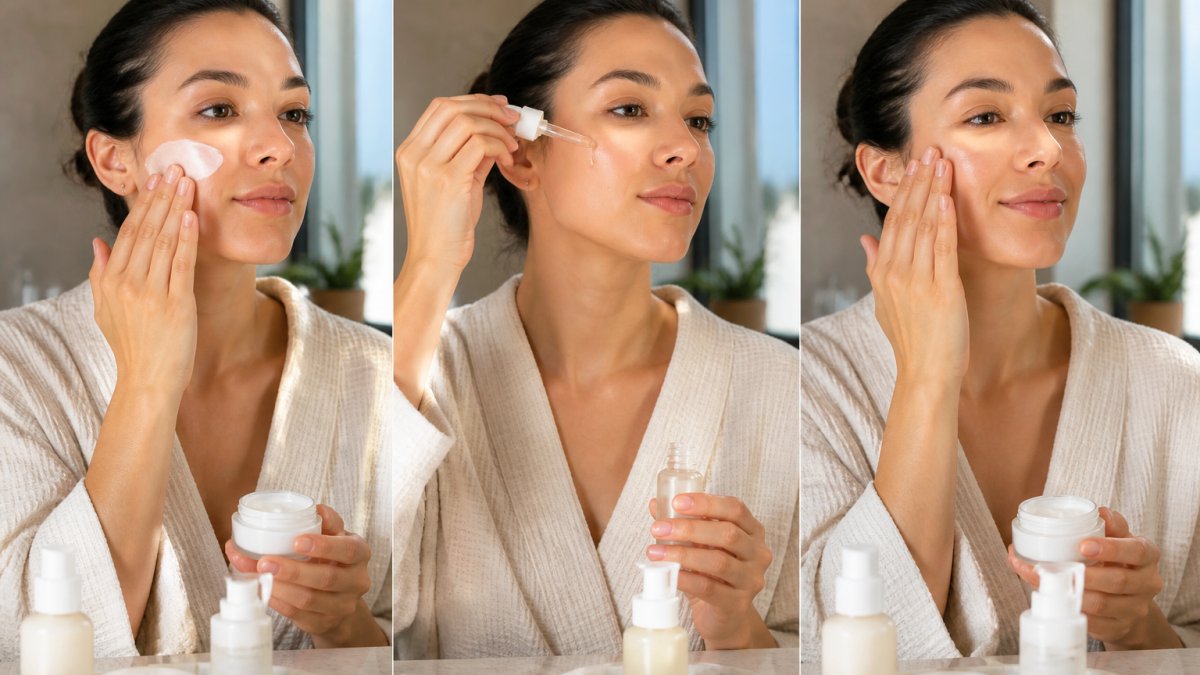
Apply a thin moisturizer layer, let it set for a minute, add your retinol serum, then finish with another light moisturizer application. This is especially valuable during your first 2-4 weeks of retinol use.
A properly moisturized skin barrier tolerates retinol better and shows steadier improvement. Many people transition to direct application after a few weeks, but the sandwich method is a smart starting point.
How to Layer Retinol With Other Serums
Layering retinol correctly prevents ingredient conflicts and maximizes routine effectiveness.
Apply retinol after lighter, water-based serums and before heavier creams. A typical order looks like this: gentle cleanser → toner or essence → lightweight hydrating serum (like hyaluronic acid) → retinol serum → moisturizer → SPF (morning only).

Safe Pairings With Retinol
Hyaluronic acid and retinol work synergistically. Apply hyaluronic acid first, let it absorb for a minute, then apply retinol. This is especially valuable when you use retinol for better results on drier skin types.
Ceramides, peptides, and squalane strengthen the skin barrier and reduce irritation without interfering with retinoid function. Ceramide-rich products reduce flaking by 30-40% compared to retinol alone.
Glycerin is also safe; it draws moisture into the skin and works well before or after retinol.
Ingredients to Avoid in the Same Routine
Vitamin C (L-ascorbic acid) and retinol should not be used together in the same routine. Both are powerful oxidizing agents. When combined, they can destabilize each other, reducing efficacy of both ingredients and increasing irritation. The pH requirements also conflict: vitamin C works best at pH 3.5 or lower, while retinol prefers a neutral pH. If you want to use both, alternate them on different nights, retinol on Monday, Wednesday, Friday; vitamin C on Tuesday, Thursday.
Separate AHAs and BHAs from retinol, as both increase cell turnover and overwhelm your barrier when used simultaneously, especially in the first 8-12 weeks. After 12 weeks, you may cautiously introduce gentle exfoliating acids on alternate nights if your skin shows no sensitivity.
High-dose niacinamide (5% or higher) can trigger irritation with retinol in sensitive skin. Keep niacinamide below 4% and introduce it only after week 8, starting on alternate nights.
Retinoids and benzoyl peroxide are generally incompatible. Benzoyl peroxide is an oxidizing agent that can degrade retinol and retinoids, reducing their effectiveness. If you're treating acne with benzoyl peroxide, use it in the morning and reserve retinol for your evening routine only.
Fragrance and Essential Oils
Choose fragrance-free products when building a retinol routine. Fragrance, synthetic or from essential oils, can irritate skin already managing an active ingredient.
Timing and Spacing
Maintain at least one full rest day between different actives. During your first 12 weeks on retinol, avoid any other actives entirely.
How Often to Use Retinol for Beginners
Beginners should start slowly when you use retinol for better results. Your skin needs time to build tolerance.
Week 1-2: Use retinol once per week. This allows your skin to adapt without overwhelming your barrier. Many people experience some flaking or mild redness at this stage. That's normal adjustment, not damage.
Week 3-4: Increase to twice per week if your skin tolerates the once-weekly application well. If you're experiencing persistent redness, flaking, or irritation, stay at once weekly for another 2-4 weeks.
Week 5+: Move to three times per week if your skin is stable. This is a good maintenance frequency for many people. Some eventually work up to every other night or nightly use, but that requires several months of gradual progression.
Never jump frequencies rapidly. Rushing causes irritation that discourages continued use.
If you see persistent redness, severe flaking, or increased sensitivity, scale back frequency. Steady, sustainable progress wins.
Apply SPF Every Morning
Sun protection is essential when you use retinol for better results. Retinol increases sun sensitivity, and without SPF you undo the benefits and accelerate aging.
Apply broad-spectrum SPF 30 or higher every morning, even on cloudy days. A daily SPF habit is non-negotiable during retinol use.
Apply SPF as your final morning step. Choose a lightweight formula that won't pill under makeup.
Reapply SPF every two hours during extended outdoor time, especially in the first 3-6 months of retinol use.
Manage Skin Irritation and Purging
Most people experience redness, flaking, or mild irritation in the first 4-6 weeks when you use retinol for better results. Knowing how to respond when irritation escalates separates success from abandonment.
Normal Adjustment vs. True Irritation
Skin purging is common as retinol accelerates cell turnover. Purging typically lasts 2-4 weeks and is a sign the retinol is working. Breakouts are usually smaller and resolve faster than typical acne.
Light flaking, mild redness that fades within a few hours, and slight dryness are normal in weeks 1-4. These symptoms improve with consistent moisturizing and typically resolve by week 6 as your skin barrier adapts.
True irritation, persistent redness that doesn't fade throughout the day, burning or stinging that lasts more than 15 minutes after application, severe flaking that worsens despite heavy moisturizing, or signs of barrier damage like increased sensitivity to water or other products, requires immediate intervention.
Barrier Recovery Protocol
If you develop true irritation, follow this step-by-step recovery plan:
Days 1-3: Pause and Reset Stop using retinol entirely for 3-5 days. Your skin barrier needs a break from active ingredients. During this pause, use only a gentle cleanser and a heavy, occlusive moisturizer. Look for products containing ceramides (ceramide NP, ceramide AP, or ceramide EOP), which are the primary lipids in your skin barrier. Apply moisturizer to damp skin to lock in hydration. If your skin feels extremely tight or uncomfortable, apply moisturizer twice daily.
Avoid all other actives during this pause, no vitamin C, no exfoliating acids, no niacinamide, no benzoyl peroxide. Your skin is signaling that it cannot handle additional stressors.
Days 4-7: Introduce Barrier Repair Once acute irritation subsides (redness decreases, burning stops), introduce a dedicated barrier-repair product. Look for serums or creams containing:
- Centella asiatica (cica), which reduces inflammation and supports barrier healing
- Panthenol (provitamin B5), which hydrates and soothes irritated skin
- Cholesterol, a key structural lipid in the skin barrier
- Arachidic acid or other fatty acids that mimic your skin's natural lipid profile
Apply barrier-repair products before your moisturizer. Many people see significant improvement within 3-5 days of consistent barrier-repair use. The redness fades, flaking decreases, and skin sensitivity normalizes.
Week 2: Restart Retinol at Lower Frequency Once your skin feels comfortable and irritation has resolved, restart retinol at a much lower frequency than before. If you were using it twice weekly, drop back to once every 10 days. If you were using it once weekly, drop to once every 14 days.
Use the sandwich method during this restart phase: apply a light moisturizer, wait one minute, apply retinol, wait one minute, apply another layer of moisturizer. The buffering effect of the sandwich method reduces irritation by approximately 40-50% compared to direct application, giving your barrier time to strengthen.
Ongoing Adjustments If irritation returns during the restart phase, pause retinol again for 3-5 days, extend your barrier-repair routine, and restart at an even lower frequency (every 3 weeks instead of every 2 weeks). Some skin types need 12-16 weeks to fully adapt to retinol, not the standard 8-12 weeks.
Once you've successfully used retinol at a given frequency for 4 consecutive weeks without irritation, you can increase frequency by one application every 7-10 days. This slow progression prevents the boom-and-bust cycle where people push too hard, irritate their skin, pause, and start over.
When to Consider a Different Retinol Strength
If you're using a high-strength retinol (0.5% or higher) and experiencing persistent irritation even after barrier recovery, consider switching to a lower-strength retinol or a gentler retinoid like retinyl palmitate or retinaldehyde.
Conversely, if you're using a very low-strength retinol (0.025% or lower) and experiencing irritation, the issue may not be the retinol itself but rather other products in your routine or an underlying skin barrier condition. In this case, focus on barrier repair and simplification rather than changing the retinol.
| Timeline | Symptom | Action | Expected Outcome |
|---|---|---|---|
| Weeks 1-2 | Light flaking, mild redness | Continue retinol, increase moisturizer | Symptoms resolve by week 4 |
| Weeks 3-4 | Persistent redness, burning | Reduce frequency to 1x every 10 days | Improvement within 1 week |
| Week 5+ | Severe irritation, barrier damage | Pause 3-5 days, use barrier repair, restart at 1x every 14 days | Full recovery in 2-3 weeks |
| Week 8+ | Stable, minimal irritation | Gradually increase frequency by 1x per week | Reach target frequency by week 12 |
Frequently Asked Questions
How often should beginners use retinol?
Start with retinol once or twice per week, allowing your skin to adjust over 2-4 weeks before increasing frequency. Beginners should never apply retinol every night initially, as this causes excessive irritation and flaking. Once your skin barrier strengthens, you can gradually move to 3-4 times weekly. The Collagen and Retinol Serum from EVERGRENE is formulated for all skin types, making it ideal for those just starting their retinol journey.
What should you never mix with retinol?
Avoid combining retinol with vitamin C, benzoyl peroxide, or other retinoids on the same night, as these combinations increase irritation and reduce efficacy. Retinol also shouldn't be mixed with AHAs or BHAs in the same application. However, you can safely layer retinol with hydrating ingredients like hyaluronic acid and moisturizer using the sandwich method, which actually enhances results and minimizes irritation.
How long does it take to see results from retinol?
Most people notice improvements in skin texture and fine lines within 6-12 weeks of consistent use, though some see subtle changes after 4 weeks. Results depend on retinol strength, application frequency, and your skin's adjustment period. Collagen production and cell turnover accelerate over time, leading to firmer, smoother skin. Patience and consistency matter more than expecting overnight transformation.
Can you use glycolic acid and retinol together?
Glycolic acid and retinol can be used together, but not on the same night when you're starting out. Once your skin has fully adjusted to retinol (typically after 8-12 weeks), you can alternate nights or use them in a carefully planned weekly rotation. Never apply both to clean skin simultaneously, as this combination causes excessive peeling and barrier damage. Always moisturize heavily when using either active ingredient.