
How to Build Consistent Skincare Habits That Last
Table of Contents
- Why Consistency Beats Perfection in Any Skincare Routine
- Start with a Minimalist Skincare Routine You Can Actually Follow
- Habit Stacking: Attach Skincare to Routines You Already Have
- Skincare Habit Tracking: Simple Ways to Stay Accountable
- How Long to See Skincare Results (and Why Patience Matters)
- The Best Skincare Tools for Daily Use That Fit Your Lifestyle
- Troubleshooting Routine Fatigue and Psychological Barriers
- Frequently Asked Questions
Last Updated: September 16, 2026
Why Consistency Beats Perfection in Any Skincare Routine
The most effective skincare product is the one you actually use every day. That sounds simple, but it's the single biggest reason routines fail. This guide from EVERGRENE covers how to build consistent skincare habits that survive real life, not just a motivated weekend.
Most people don't quit because their products stop working. They quit because the routine became too long, too complicated, or too easy to skip. When you're tired at 11 p.m., a ten-step regimen loses to a pillow every time. A three-step routine you never miss will outperform a perfect routine you abandon by week two.
Below, we'll show you exactly how to build a minimalist skincare routine, stack it onto habits you already have, and track progress in ways that keep you going when results are slow. The approach is built around one idea: consistency is a skill you design for, not a personality trait you either have or don't.
Start with a Minimalist Skincare Routine You Can Actually Follow
A minimalist skincare routine is a short daily regimen built around the fewest steps that still support skin health. For most people, that means three steps in the morning and three at night, with room to add a targeted treatment once the basics feel automatic.
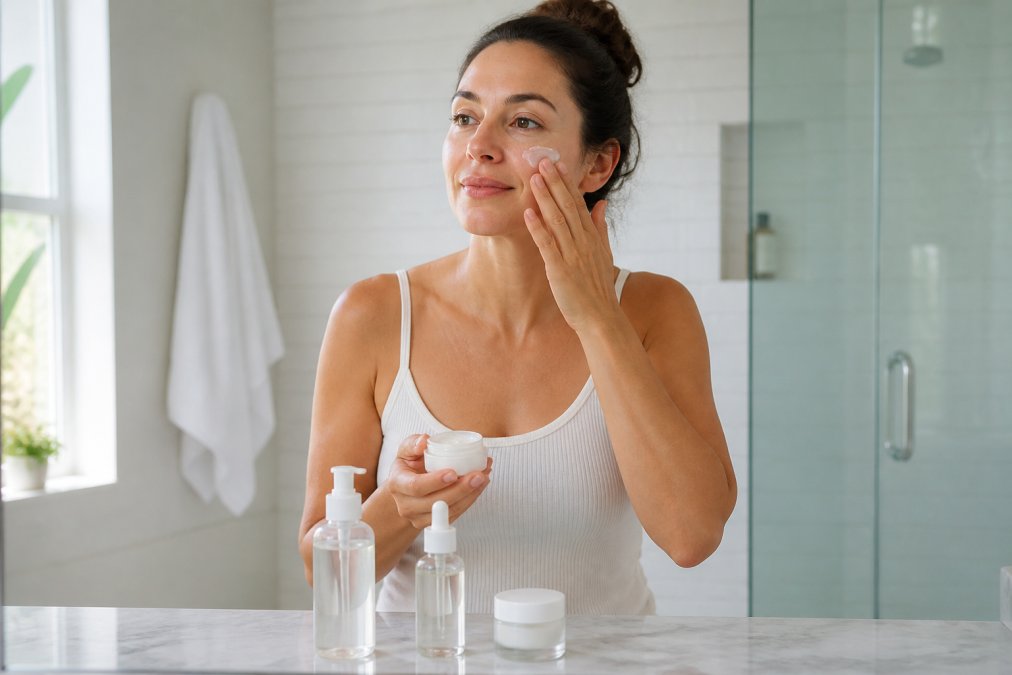
The logic here is counterintuitive. Fewer products mean more consistency, and more consistency means better skin. A common mistake is buying five new products at once and expecting motivation to carry you through. It won't. Start with the steps below and add nothing until they feel as automatic as brushing your teeth.
The Three Non-Negotiables: Cleanse, Moisturize, Protect
Every routine, no matter how simple, needs these three steps. Skip them and no serum will compensate.
- Cleanse: A gentle cleanser removes oil, dirt, and leftover product without stripping the skin barrier. The Kale Face Cleanser fits this step for all skin types, with kale protein to protect the moisture barrier and aloe vera and green tea to hydrate.
- Moisturize: Hydration keeps the skin barrier intact. The Oil-Free Daily Moisturizer delivers all-day hydration without a greasy finish, and its panthenol content helps reduce redness for sensitive skin.
- Protect: A broad-spectrum SPF every morning is the closest thing skincare has to preventative care. It's also the step people skip most.
How to Add Active Ingredients Without Overwhelming Your Skin
Add one active at a time, and give it two to three weeks before adding another. This is the rule that separates people who tolerate active ingredients from people who irritate their skin and quit.


A practical sequence looks like this:
- Weeks 1-3: Cleanse, moisturize, SPF only. Let your skin adjust to the basics.
- Weeks 4-6: Add a hydrating serum such as the Hyaluronic Acid Serum, which supports elasticity and barrier strength.
- Weeks 7-9: Introduce one exfoliating active, such as the Glycolic Acid Serum, two or three nights a week.
If your skin stings, flakes, or turns red, cut back to the previous step for a week. That's not failure; it's calibration. The goal is a routine your skin tolerates long enough to show results.

Habit Stacking: Attach Skincare to Routines You Already Have
Habit stacking works by attaching a new behavior to an existing one, so the old habit becomes the trigger for the new one. You don't rely on remembering; you rely on sequence.
The technique is simple. Finish one action, start the next. Your existing morning and evening routines already run on autopilot, which makes them the perfect anchor points:
- After you brush your teeth at night, cleanse.
- After you cleanse, moisturize.
- After you pour your morning coffee, apply SPF.
- After you turn off your bedside lamp, apply your evening treatment.
The thing nobody tells you about habit stacking is that the anchor matters more than the new habit. Pick an anchor you never skip, and the skincare step rides along with it. Pick a shaky anchor, and both habits fall apart together.
Skincare Habit Tracking: Simple Ways to Stay Accountable
Skincare habit tracking is the practice of recording whether you completed your routine, not how your skin looks. That distinction matters, because visible results lag behind behavior by weeks, and tracking the wrong thing makes people quit early.
Keep it almost embarrassingly simple. A paper calendar with an X for each completed routine works better than an elaborate app you'll stop opening. If you prefer digital, a notes app checklist or a habit tracker on your phone does the same job.
What matters most is tracking compliance, not perfection. Missing one night doesn't break the streak; quitting does. Some people find that a visible streak is motivating, while others find it stressful. If streaks make you anxious, track weekly totals instead: five out of seven nights is a win, not a failure.
How Long to See Skincare Results (and Why Patience Matters)
Most people see early changes in skin hydration and texture within two to four weeks, while improvements in tone, fine lines, and hyperpigmentation typically take eight to twelve weeks of consistent use. The timeline depends on the active ingredient and your skin's own renewal cycle.
This is where patience becomes a practical skill rather than a virtue.
The Best Skincare Tools for Daily Use That Fit Your Lifestyle
Friction type 1: Physical setup. A device that needs charging, a mask that needs mixing, a tool that needs cleaning before and after, each adds a step between you and done. The fix is to choose tools that are ready when you are. A pump dispenser is ready. A jar that needs a spatula is not.
| Your Situation | What to Prioritize | What to Avoid |
|---|---|---|
| Busy mornings, 5 minutes | Multi-purpose products, pump dispensers | Multi-step devices needing setup |
| Sensitive skin | Fragrance-free formulas, gentle applicators | Harsh scrubs, high-frequency tools |
| Travel or gym routines | Compact, spill-proof packaging | Bulky devices, glass bottles |
| Evening wind-down | Products that feel pleasant to apply | Anything that adds friction |
| Shared bathroom | Personal caddy or bin | Products scattered across counters |
Budget-friendly consistency matters here too. An expensive routine you feel guilty about skipping is harder to sustain than an affordable one you use daily. The goal isn't the most sophisticated setup, it's the one that survives your real life.
Troubleshooting Routine Fatigue and Psychological Barriers
Routine fatigue is the point where a skincare regimen starts to feel like a chore instead of self-care. It's not a discipline problem; it's a design problem, and it has a fix.
- Fight fading novelty by rotating one product at a time, so there's always something slightly new without overhauling everything. The novelty is a feature, not a bug, use it deliberately.
- Reduce decisions by keeping the same order every day. No thinking, no choosing. Write the order on a sticky note on your mirror for the first two weeks.
- Break the all-or-nothing trap by defining a minimum routine: cleanse and moisturize on your worst nights, full routine on your best. The minimum routine is not a failure state, it's the floor that keeps the habit alive.
- Lower the initiation cost by pre-setting your products the night before. If the cleanser is already on the counter and the moisturizer is uncapped, the barrier to starting drops.
- Pair with a sensory anchor, a song, a podcast, or a specific playlist you only play during your routine. The sensory cue becomes the trigger when motivation is absent.
Frequently Asked Questions
How long does it take to see results from a consistent skincare routine?
Most skincare ingredients need four to six weeks of consistent use before you notice visible changes, and some active ingredients like retinol can take up to twelve weeks. Your skin cell turnover cycle runs roughly twenty-eight days, so results build gradually. Track non-visual progress too, like how your skin feels and whether products absorb better. Patience with your skincare habits matters more than switching products frequently.
What should I do if I keep forgetting my skincare routine?
Try habit stacking, which means attaching your skincare steps to something you already do without thinking. For example, apply serum right after brushing your teeth or moisturizer immediately after your evening shower. Keep products visible on the counter rather than in a drawer. Setting a phone reminder for the first two weeks also helps your skincare habits become automatic.
Is it better to have a simple or complex skincare routine for consistency?
A minimalist skincare routine with three to five products is easier to maintain than a ten-step regimen. Research on habit formation shows that simpler routines have higher adherence rates. Start with a gentle cleanser, moisturizer, and broad-spectrum SPF in the morning. Add targeted treatments like glycolic acid or retinol only after your basic skincare habits feel automatic.
How can I stay consistent with skincare when I am busy or traveling?
Pack travel-sized versions of your core products and stick to your essentials: cleanser, moisturizer, and SPF. Use skincare habit tracking apps or a simple checklist to maintain accountability even when your schedule changes. The goal is routine maintenance, not perfection. Missing one night will not undo your progress, but abandoning your skincare habits for a week will set you back.