
Benefits of Glycolic Acid for Face: A 2026 Guide
Table of Contents
- What Glycolic Acid Actually Does to Your Skin
- The Real Benefits of Glycolic Acid for Face
- How to Use Glycolic Acid in Your Skincare Routine
- Glycolic Acid Concentration for Beginners
- Glycolic Acid and Retinol Layering: What Works
- Glycolic Acid Side Effects and How to Avoid Them
- Conclusion
- Frequently Asked Questions
Last Updated: September 14, 2026
What Glycolic Acid Actually Does to Your Skin
Glycolic acid is an alpha hydroxy acid (AHA) derived from sugarcane that loosens the bonds holding dead cells to your skin's surface, accelerating the natural shedding process known as exfoliation. At EVERGRENE, we think of it as a chemical exfoliant that works with your skin's biology rather than against it.

Here's what most guides get wrong: they promise overnight transformation. In reality, glycolic acid works gradually by increasing cell turnover in the epidermis, the outer layer of your skin, so fresh cells reach the surface faster. The result is less dullness, smoother skin texture, and better light reflection, which is what people actually mean when they say "radiance."
That said, the ingredient's small molecular size is both its advantage and its risk. It penetrates quickly, which makes it effective, but it also means concentration and pH level matter enormously. Get those wrong and you're looking at redness and irritation instead of results. Below, we'll show you exactly how to use it without the trial-and-error most people endure.
The Real Benefits of Glycolic Acid for Face
The benefits of glycolic acid for face center on exfoliation, hydration support, and long-term collagen production. Research from the American Academy of Dermatology on chemical exfoliants confirms that AHAs like glycolic acid are dermatologist-recommended for improving skin texture when used correctly.
A common mistake is expecting results from one application. Glycolic acid works cumulatively, and most people see visible improvement in skin texture and tone over several weeks of consistent use, not days.
Smoother Texture and Brighter Tone
Glycolic acid dissolves the bonds between dead skin cells sitting on the stratum corneum, allowing them to shed evenly instead of clumping. That clumping is what creates rough patches and a dull, uneven surface. Regular exfoliation with glycolic acid reveals fresher skin underneath, which reflects light more evenly, giving you a brighter, more even tone.
Fading Dark Spots and Sun Damage
Hyperpigmentation, whether from sun damage, past breakouts, or melanin clustering, sits in the upper layers of the epidermis. Because glycolic acid speeds up cell turnover, pigmented cells are pushed to the surface and shed faster. This gradual process can visibly fade dark spots over time, though it requires patience and daily broad-spectrum sunscreen to prevent new damage.
Fine Lines and Collagen Support
Over time, glycolic acid use is associated with increased collagen production in the deeper skin layers. This is where the anti-aging benefit comes from: improved skin firmness and a softening of fine lines, particularly around the eyes and mouth. It's not a filler or a botulinum treatment, but consistent use supports your skin's own repair mechanisms.
How to Use Glycolic Acid in Your Skincare Routine
The best way to use glycolic acid is to start with a low concentration at night, two to three times per week, and build from there. Nighttime use is standard because glycolic acid increases photosensitivity, making your skin more vulnerable to UV damage during the day.
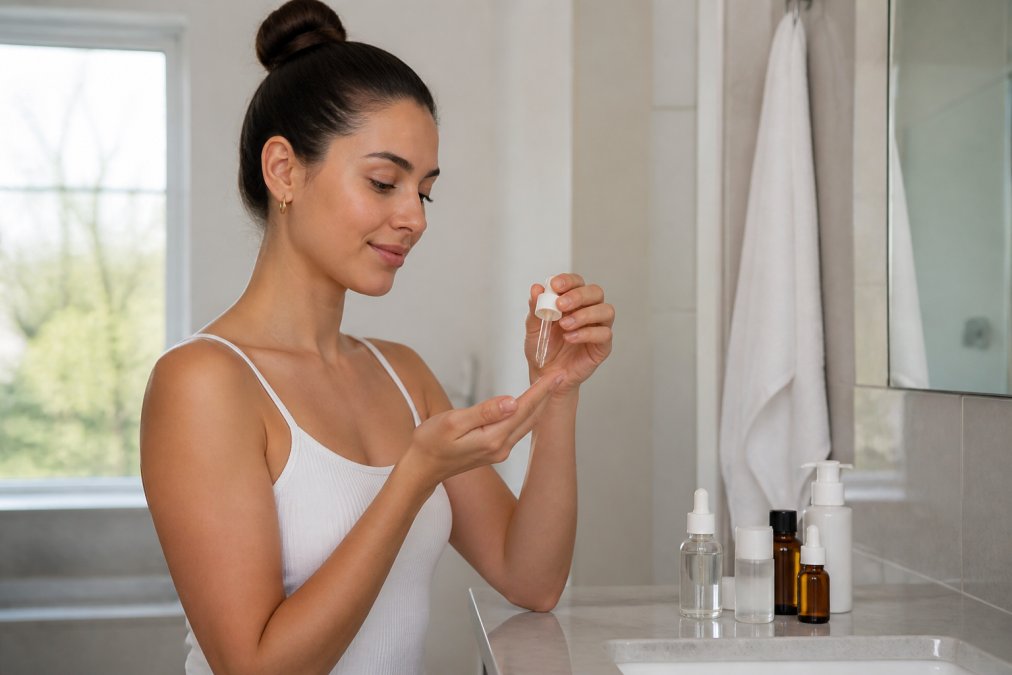
A Simple Step-by-Step Routine
- Cleanse with a gentle, non-stripping cleanser. Skip physical scrubs on glycolic acid nights.
- Apply glycolic acid to dry skin. Start with 2-3 drops of a serum, avoiding the eye area and any broken skin.
- Wait 2-3 minutes for absorption. A mild tingling sensation is normal; burning is not.
- Follow with a moisturizer to support your skin barrier and reduce irritation risk.
- Apply broad-spectrum sunscreen every morning, without exception.
A common mistake is layering glycolic acid with too many other active ingredients on the same night. Keep it simple: one active, one moisturizer, done.
Glycolic Acid Concentration for Beginners
Beginners should start with a glycolic acid concentration between 5% and 10% (the American Academy of Dermatology). This range delivers exfoliation benefits while keeping irritation manageable for most skin types. Higher concentrations, typically 20% and above, are reserved for professional chemical peels performed under supervision.
For at-home products, the pH level matters as much as the percentage. Glycolic acid needs an acidic pH to work, but formulas that are too acidic strip the skin barrier. A well-formulated serum balances both.
EVERGRENE's Glycolic Acid Serum ($46.70) pairs glycolic acid with glycerin, vitamin E, and squalane. That combination matters: the humectants and antioxidants buffer the exfoliation so your skin stays hydrated while it renews. If you're coming from drugstore exfoliants, expect a gentler experience with more consistent results over time.
Glycolic Acid and Retinol Layering: What Works
Glycolic acid and retinol can be layered, but not on the same night when you're starting out. Both ingredients accelerate cell turnover, and combining them too soon overwhelms the skin barrier, leading to redness, flaking, and irritation.
The safer approach is to alternate: glycolic acid two nights per week, retinol two other nights, and recovery nights in between with just moisturizer.
| Night | Active | Purpose |
|---|---|---|
| Monday | Glycolic acid | Exfoliation and texture |
| Tuesday | Moisturizer only | Barrier recovery |
| Wednesday | Retinol | Collagen support |
| Thursday | Moisturizer only | Barrier recovery |
| Friday | Glycolic acid | Exfoliation and tone |
| Saturday | Retinol | Fine lines and firmness |
| Sunday | Moisturizer only | Full recovery |
Once your skin tolerates this for several weeks, some people combine both in one evening, applying glycolic acid first, waiting, then retinol. That's an advanced move, not a starting point. Guidance from the U.S. Food and Drug Administration on cosmetic ingredients reinforces that irritation risk rises with combined active use, so introduce one variable at a time.
What Not to Mix With Glycolic Acid
Most guides stop at retinol. The layering questions people actually search for are broader, and the answers depend on pH, timing, and how many actives your barrier can tolerate in one sitting.
Vitamin C. Both are acids, and layering them back-to-back can push the skin past its comfort zone. The practical fix is to split them by time of day: vitamin C in the morning under sunscreen, glycolic acid at night. If you want both in one routine, separate them by at least 15 minutes and watch for stinging on the second application.
Niacinamide. Generally compatible. Niacinamide is close to pH-neutral and buffers the acid's sting, which is why many well-formulated glycolic serums include it. Apply glycolic first, let it absorb, then follow with a niacinamide moisturizer.
Peptides. Best kept on separate nights. Glycolic acid's low pH can destabilize some peptide chains, and the exfoliation itself removes the surface cells peptides are meant to support. Use peptides on your recovery nights.
Benzoyl peroxide. Do not layer in the same routine. Both are drying, and benzoyl peroxide's oxidizing action plus glycolic's acid load is a common recipe for a compromised barrier. Alternate days instead.
Hyaluronic acid. Compatible and useful. Apply it after the glycolic acid has absorbed to pull water into the skin and offset the tightness that follows exfoliation.
Physical scrubs and cleansing brushes. Skip them on glycolic nights. Mechanical exfoliation on top of chemical exfoliation is the fastest route to over-exfoliation.
Why pH and Timing Matter More Than the Ingredient List
Glycolic acid needs an acidic pH, typically around 3.5 to 4.0 in a well-formulated at-home product, to exfoliate effectively. When you layer another acid on top before the first has absorbed, you can drive the combined pH lower than your skin tolerates. That's why the wait time between steps isn't arbitrary. Two to three minutes lets the acid finish its work and the skin begin returning toward its natural pH before the next product lands.
A common pattern among people who react badly to glycolic acid isn't a sensitivity to the ingredient at all, it's stacking three or four actives in one evening and blaming the acid. Introduce one new active at a time, give it two to three weeks, and only then add the next.
Glycolic Acid Side Effects and How to Avoid Them
The most common glycolic acid side effects are redness, stinging, dryness, and increased sun sensitivity. Most are manageable with proper introduction and a consistent moisturizer. A patch test on your inner forearm before first use is the simplest way to check tolerance.
Watch for these warning signs that you're overdoing it:
- Persistent redness lasting more than a day
- Burning rather than tingling during application
- Flaking or peeling beyond mild dryness
- New sensitivity to products you previously tolerated
If any appear, pause the acid for a week, focus on barrier repair with a simple moisturizer, and restart at a lower frequency.
Sensitive skin types should start at the lowest effective concentration and space applications further apart. There's no prize for rushing.
How to Tell Irritation From Over-Exfoliation
Mild tingling for the first 30 to 60 seconds after application is normal and usually fades as your skin adapts. What you're watching for is anything that persists or escalates.
| Signal | Likely Cause | What to Do |
|---|---|---|
| Brief tingling that fades | Normal acid activity | Continue as planned |
| Stinging that lasts past 5 minutes | Concentration too high or skin damp | Rinse, reduce frequency |
| Redness gone by morning | Mild transient irritation | Space applications further apart |
| Redness lasting 24+ hours | Barrier disruption | Pause all actives for 5-7 days |
| Flaking, tightness, burning | Over-exfoliation | Full barrier reset, see below |
Post-Peel and Over-Exfoliation Recovery
If you've pushed too far, whether from an at-home product or a professional peel, the goal is to stop exfoliating entirely and rebuild the barrier. This is the part most guides skip, and it's the part that determines how quickly your skin bounces back.
Days 1-3: Stop everything. No glycolic acid, no retinol, no vitamin C, no physical scrubs, no cleansing brushes. Wash with lukewarm water and a fragrance-free, non-foaming cleanser. Apply a plain ceramide moisturizer two to three times a day. If your skin stings even from water, use a barrier ointment instead.
Days 3-7: Add back the basics. Keep the routine to cleanser, moisturizer, and sunscreen. Look for ceramides, cholesterol, fatty acids, panthenol, and squalane, the ingredients that rebuild the lipid barrier rather than just sitting on top of it. Avoid essential oils, fragrance, alcohol denat, and any exfoliating acids during this window.
Week 2: Reassess. If redness and flaking have resolved, you can reintroduce glycolic acid at half your previous frequency and a lower concentration. If your skin is still reactive, extend the recovery period. There's no fixed timeline, the skin sets the schedule.
When to see a dermatologist. If you have blistering, oozing, severe swelling, or pain that doesn't improve within a few days, that's beyond at-home recovery. Persistent post-inflammatory hyperpigmentation after a peel is also worth a professional evaluation, since it may need a different treatment approach than more exfoliation.
Preventing the Problem in the First Place
The most reliable way to avoid side effects is to introduce glycolic acid more slowly than you think you need to. Start at 5% once a week for two weeks, then twice a week for two weeks, then three times a week if your skin is comfortable. Only increase concentration after you've tolerated the frequency for at least a month.
Pair every glycolic acid night with a moisturizer, and never apply the acid to damp skin or immediately after cleansing without letting your skin dry completely. Both habits reduce penetration speed and cut irritation risk significantly.
Conclusion
Building a routine around glycolic acid takes patience, and the biggest challenge is resisting the urge to do too much too fast. The payoff, smoother texture, faded dark spots, and softer fine lines, comes from consistency, not intensity.
EVERGRENE formulates its Glycolic Acid Serum with glycerin, vitamin E, and squalane to support hydration and repair alongside exfoliation, so you get results without stripping your skin barrier. If you want a straightforward, effective exfoliation step that fits into a busy routine, start there.
Get started with EVERGRENE and build a skincare routine that delivers visible results without the guesswork.
Frequently Asked Questions
Can you use glycolic acid on your face daily?
Daily use is possible for some people, but it is not the right starting point. Begin with two or three nights per week and watch how your skin responds. If you notice only a mild tingling that fades within a minute and no lasting redness, you can gradually increase frequency. Many dermatologists suggest capping at five nights per week for most skin types. Using it daily from day one often leads to a damaged skin barrier, which causes more problems than it solves.
What should you not mix with glycolic acid?
Avoid layering glycolic acid in the same routine as other strong exfoliants like salicylic acid or lactic acid, and skip physical scrubs on the same night. Retinol can be used in the same routine with care, but not at the same time on the same layer. Vitamin C serums are best used in the morning while glycolic acid goes at night. Benzoyl peroxide can also cause irritation when combined. When in doubt, alternate nights rather than stacking products.
How long should I use glycolic acid on my face before seeing results?
Most people notice smoother texture and a brighter tone within two to four weeks of consistent use. Dark spots and hyperpigmentation take longer, often eight to twelve weeks, because they sit deeper in the epidermis and require repeated cell turnover cycles to fade. Fine lines respond over a similar timeline. Consistency matters more than concentration. A lower percentage used regularly will outperform a high percentage used sporadically.
Is glycolic acid safe for sensitive skin?
It can be, but sensitive skin needs a lower concentration and a slower introduction. Start with a product in the 5% range, do a patch test on your inner arm 24 hours before applying to your face, and use it once a week at first. Buffering with a moisturizer before or after application can reduce stinging. If you have rosacea, eczema, or a compromised skin barrier, talk to a dermatologist before starting. Signs of true irritation include persistent redness, burning, and peeling.
Does glycolic acid help with acne scars?
It helps with certain types. Glycolic acid speeds up cell turnover, which fades post-inflammatory hyperpigmentation, the flat dark marks left behind after a breakout. It also clears pore congestion that leads to new acne. However, it does not remodel indented or pitted scars, which are structural changes in the skin. Those typically require in-office treatments like chemical peels at higher concentrations or laser therapy. For surface-level dark spots, at-home glycolic acid is a solid first step.
How do I layer glycolic acid with retinol without irritating my skin?
The safest approach is to alternate nights: glycolic acid one evening, retinol the next. If your skin tolerates both well, you can use them in the same routine by applying glycolic acid first, waiting five to ten minutes, then applying a pea-sized amount of retinol. Always follow with a moisturizer. Start with this combined approach once a week and increase only if your skin stays calm. A serum like EVERGRENE's Glycolic Acid Serum pairs well with a gentle retinol when introduced carefully.