
Choosing Non-Comedogenic Products for Reactive Skin
Table of Contents
- What Non-Comedogenic Means and Why It Matters for Reactive Skin
- How to Identify Comedogenic Ingredients on Product Labels
- Distinguishing Comedogenicity from Irritation and Allergic Reactions
- Patch Testing Skincare Products Before Full Application
- How to Introduce New Skincare Products Gradually Without Triggering Breakouts
- Selecting a Non-Comedogenic Moisturizer for Sensitive Skin
- Building Your Non-Comedogenic Skincare Routine Across Product Categories
- What to Do After a Skin Reaction
- Frequently Asked Questions
Last Updated: October 17, 2026
What Non-Comedogenic Means and Why It Matters for Reactive Skin
Non-comedogenic means a product won't clog your pores or trigger breakouts. When you have reactive skin, choosing non comedogenic products for reactive skin becomes essential because your skin barrier is already compromised and prone to inflammation.
Comedones are clogged pores. They form when dead skin cells, oil, and bacteria get trapped inside. Blackheads and whiteheads are both types of comedones. If your skin is reactive, adding pore-clogging ingredients makes everything worse.
Reactive skin reacts strongly to products. It gets red, itchy, or breaks out easily. This happens because your skin barrier is weakened. A weakened barrier can't protect itself from irritants or bacteria. Non-comedogenic formulas help by avoiding ingredients known to block pores.
Here's what matters: not every skin reaction is caused by clogged pores. Some reactions come from irritation or allergies. Understanding the difference helps you choose the right products.
How to Identify Comedogenic Ingredients on Product Labels
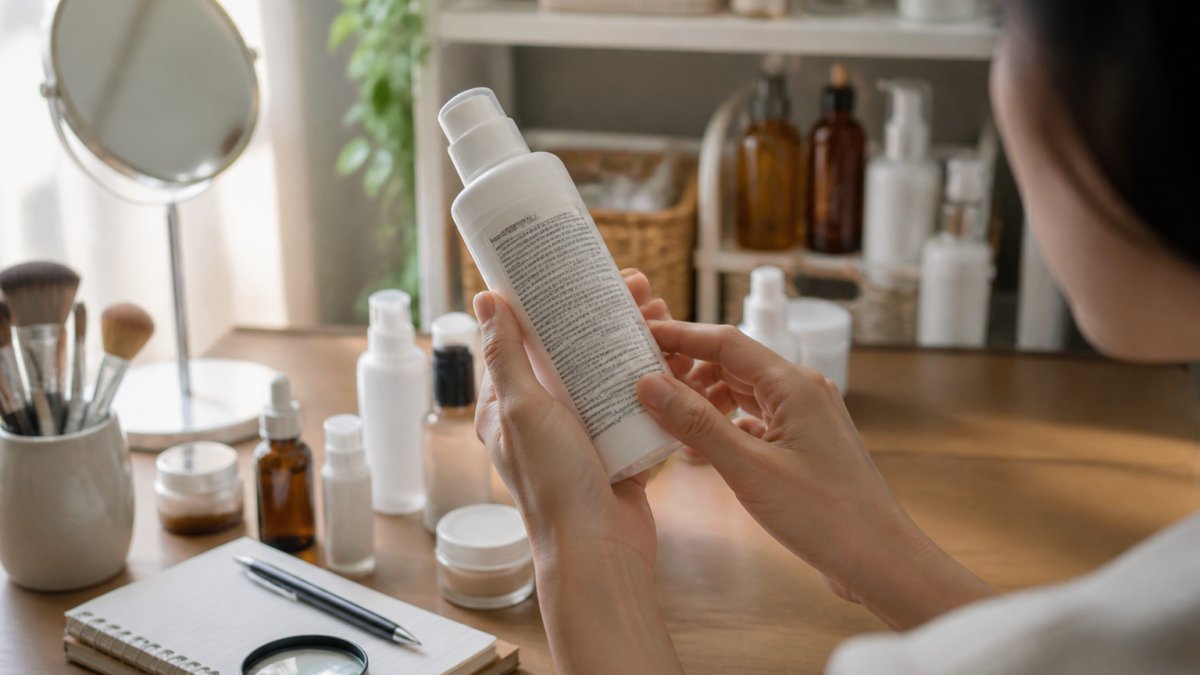
Reading the ingredient list is the most reliable screening tool you have, but it is a screening tool, not a verdict. The list tells you what is in a product and roughly how much of it, because ingredients appear in descending order of concentration until you reach the point where they drop below 1 percent.
Start with the first five ingredients. These make up the bulk of the formula. If a heavy butter, oil, or ester appears there, the product is likely too rich for pore-prone or reactive skin. If the first five are water, glycerin, a lightweight emollient, and a barrier ingredient, the base is probably workable.
Common pore-clogging ingredients to scan for:
- Coconut oil and coconut-derived butters
- Cocoa butter and shea butter in leave-on products
- Lanolin and lanolin alcohols
- Isopropyl myristate and isopropyl palmitate
- Oleic acid and oleyl alcohol
- Heavy mineral oil formulations
- Some silicones, especially in thick occlusive creams
- Waxes such as beeswax and carnauba in high concentrations
Ingredients that generally support reactive, pore-prone skin:
- Glycerin
- Hyaluronic acid
- Niacinamide
- Dimethicone (a lightweight silicone that usually does not clog)
- Squalane
- Ceramides
- Panthenol
The label is not a universal guarantee. There is no single standard for the term "non-comedogenic." Manufacturers test differently, some on animal skin, some on human backs, some not at all before using the claim.
Concentration and finished formula matter more than any single ingredient. An ingredient that clogs pores at 10 percent may be harmless at 0.5 percent.
Watch for irritants that are not pore-cloggers. For reactive skin, the ingredient list also needs a pass for fragrance, essential oils, drying alcohols, and strong acids. These do not necessarily clog pores, but they can inflame a compromised barrier and make your skin react in ways that look like breakouts.
Distinguishing Comedogenicity from Irritation and Allergic Reactions
This is where most people get confused. A breakout doesn't always mean the product clogged your pores.
Comedogenic reaction: New blackheads or whiteheads appear in the area where you applied the product. They develop slowly over days or weeks. Your skin doesn't feel inflamed or sensitive, it just has more clogged pores.
Irritation: Your skin burns, stings, or feels tight immediately after application. Redness spreads across the area. It feels uncomfortable but not necessarily itchy. Irritation usually fades when you stop using the product.
Allergic reaction: Itching, swelling, or hives appear within minutes to hours. The reaction is localized to where you applied it, or it spreads. Your skin may feel hot or develop a rash.
Here's the practical difference: if a product causes irritation, it's not right for you, even if it's technically non-comedogenic. If it causes comedones, the formula clogs your pores. If it causes an allergic reaction, you're sensitive to an ingredient.
For reactive skin, the goal is to avoid all three. That means choosing products formulated without common irritants AND without pore-clogging ingredients AND testing them carefully before committing.
Patch Testing Skincare Products Before Full Application
Patch testing means applying a small amount of product to a small area of skin and waiting to see if a reaction happens.
Here's how to patch test:
- Choose a hidden area: inside your wrist, behind your ear, or along your jawline
- Apply a small amount (about the size of a pea)
- Wait 24-48 hours without washing that area
- Watch for redness, itching, burning, or breakouts
- If nothing happens, you can try the product on your face
If you see a reaction during the patch test, stop using the product. Don't apply it to your full face.
Patch testing takes time. Most people want to start using a new product right away. But for reactive skin, two days of waiting prevents weeks of breakouts.
How to Introduce New Skincare Products Gradually Without Triggering Breakouts
Even after a successful patch test, introduce new products slowly.
The gradual introduction method:
- Start with your current routine (the products you know your skin tolerates)
- Add ONE new product
- Use it 2-3 times per week for two weeks
- If no reaction, increase to daily use
- Wait two weeks before adding another new product
This approach lets you identify which product caused a problem if a reaction happens. If you add three products at once and your skin breaks out, you won't know which one to blame.
For reactive skin, slower is always better. A two-week gap between new products feels long, but it protects your skin barrier.
What to avoid:
- Don't combine active ingredients (like retinol and glycolic acid) when introducing new products
- Don't layer multiple new serums at once
- Don't switch cleansers and moisturizers on the same day
- Don't add a new sunscreen while testing a treatment product
Each variable makes it harder to identify what works and what doesn't.
Selecting a Non-Comedogenic Moisturizer for Sensitive Skin
A moisturizer is non-negotiable for reactive skin. Your barrier needs hydration to heal.
Look for these features:
- Lightweight texture (gel or lotion, not cream or oil)
- Fragrance-free formulation
- Ceramides or fatty acids to support barrier function
- Hyaluronic acid or glycerin for hydration
- No essential oils or alcohol
EVERGRENE's Oil-Free Daily Moisturizer ($45.00) is formulated specifically for this. It contains panthenol to reduce redness, amino acids to support skin health, and a blend of fatty acids that won't clog pores. The lightweight formula absorbs quickly and leaves no greasy residue, essential for oily or acne-prone skin.

Apply moisturizer to damp skin right after cleansing. This locks in hydration. For reactive skin, consistency matters more than the specific product. Use the same moisturizer every day for at least four weeks before deciding if it works.
Building Your Non-Comedogenic Skincare Routine Across Product Categories
A complete routine has four parts: cleanser, treatment (optional), moisturizer, and sunscreen. For reactive skin, each category has its own non-comedogenic and low-irritation checklist. Use these as filters, not as product recommendations.
Cleanser. Choose a gentle, fragrance-free formula. Avoid harsh sulfates such as sodium lauryl sulfate. Look for a pH close to skin's natural range, and prefer a lotion or gel over a foaming scrub. Cleanse twice daily, morning and night, with lukewarm water.
Treatment. This is optional. If you want a serum or exfoliant, introduce one active at a time. For reactive skin, start with a single ingredient such as niacinamide or a low-strength acid, and use it two to three times per week before increasing.
Moisturizer. Apply to damp skin within a minute of cleansing. Look for ceramides, glycerin, hyaluronic acid, or panthenol, and avoid heavy butters and oils in the first five ingredients.
Sunscreen. Use SPF 30 or higher every day. For reactive skin, prefer a fragrance-free mineral or hybrid formula, and patch test on your jawline before applying to your full face.
Makeup and other leave-on products. Foundation, concealer, and setting products sit on your skin for hours. Check them the same way you check moisturizer: fragrance-free, lightweight, and no heavy oils in the first five ingredients.
| Product Category | Purpose | Frequency | Non-Comedogenic Priority | Reactive-Skin Check |
|---|---|---|---|---|
| Cleanser | Remove oil and dirt | Twice daily | High | Fragrance-free, low-foam, non-stripping |
| Treatment | Address specific concerns | 2-5 times per week | High | One active at a time, low strength |
| Moisturizer | Hydrate and protect barrier | Twice daily | Critical | Ceramides or glycerin, light texture |
| Sunscreen | Prevent UV damage | Daily (daytime) | High | Fragrance-free, mineral or hybrid |
| Makeup | Even tone and coverage | As needed | Medium | Lightweight, no heavy oils |
Don't overcomplicate this. A simple routine with four products is better than a complex one with ten. Each additional product increases the chance of a reaction, and each new category is another variable to test.
What to Do After a Skin Reaction
If your skin reacts to a product, stop using it immediately.
Next steps:
- Cleanse gently with lukewarm water and your regular cleanser
- Apply your regular moisturizer while skin is still damp
- Avoid all other products for 24-48 hours (except cleanser, moisturizer, and sunscreen)
- Don't touch or pick at the affected area
- If itching or burning is severe, apply a cool compress for 5-10 minutes
Most reactions fade within a few days once you stop using the problematic product. If a reaction persists beyond three days or spreads across your face, contact a dermatologist.
After a reaction, wait at least two weeks before trying a new product. Your skin barrier needs time to recover.
Reactive skin demands a methodical approach. At EVERGRENE, we understand that choosing non comedogenic products for reactive skin isn't just about reading labels, it's about testing carefully, introducing slowly, and building a routine your skin actually tolerates. Start with a gentle cleanser, a barrier-supporting moisturizer like our Oil-Free Daily Moisturizer, and sunscreen. Patch test every new product. Wait between additions. Your skin barrier will thank you.
Frequently Asked Questions
What is a good non-comedogenic moisturizer for acne-prone, reactive skin?
Look for lightweight, oil-free formulas with minimal fragrance and proven non-comedogenic ratings. EVERGRENE's Oil-Free Daily Moisturizer ($45) is designed specifically for sensitive and oily skin, featuring panthenol to reduce redness and amino acids to support skin resilience without clogging pores. Apply after cleansing and follow with SPF during the day for best results.
How should I patch test a new skincare product?
Apply a small amount to a discrete area like the inside of your wrist or behind your ear. Wait 24-48 hours before assessing for redness, itching, or breakouts. If no reaction occurs, apply the product to a small facial area (like your jawline) for 3-5 days before incorporating it into your full routine. This gradual approach helps you isolate which product caused a reaction if one develops.
What ingredients should reactive, acne-prone skin avoid?
Common pore-clogging ingredients include coconut oil, cocoa butter, lanolin, and certain silicones like dimethicone in high concentrations. Reactive skin may also struggle with fragrance, essential oils, alcohol denat, and strong chemical exfoliants used too frequently. Check ingredient lists for these items and start with fragrance-free, hypoallergenic formulas designed for sensitive skin types.
Can a non-comedogenic product still irritate sensitive skin?
Yes. Non-comedogenic means a product won't clog pores, but it can still trigger irritation through fragrance, preservatives, or active ingredients like acids or retinol. Reactive skin requires both non-comedogenic formulations and gentle, hypoallergenic ingredients. Always patch test first and introduce active ingredients slowly, even if the product is labeled non-comedogenic.