
Effective Anti Aging Routine for Beginners: 2026 Guide
Table of Contents
- Why a Consistent Anti Aging Routine Beats a Complicated One
- Best Anti-Aging Ingredients for Beginners: What to Start With
- Skincare Routine Order for Morning and Night
- Retinol for Beginners Guide: How to Start Without Irritation
- SPF and Sun Protection: The Non-Negotiable Step
- Sensitive Skin, Purging, and Patch Testing Protocols
- Lifestyle Habits That Support Your Anti Aging Routine
- Frequently Asked Questions
Last Updated: September 17, 2026
Why a Consistent Anti Aging Routine Beats a Complicated One
An effective anti aging routine for beginners succeeds through consistency, not complexity. A simple three-step regimen done daily beats a ten-product routine used sporadically. This EVERGRENE guide covers what to start with, in what order, and how to avoid beginner-derailing irritation.
| Common Beginner Mistake | The Fix | Why It Matters |
|---|---|---|
| Starting 5+ products at once | Begin with 3 core steps | Isolates what works and what irritates |
| Skipping sunscreen on cloudy days | Apply SPF 30+ daily | UV exposure drives most visible aging |
| Using retinol every night immediately | Start twice weekly | Builds tolerance without a reaction |
| Exfoliating daily | Limit to 2-3 times weekly | Protects the skin barrier |
Best Anti-Aging Ingredients for Beginners: What to Start With
The best anti-aging ingredients for beginners are retinol, vitamin C, and hyaluronic acid. Together they cover cell turnover, antioxidant protection, and hydration, most early aging concerns, without overwhelming a new user. A useful guide also teaches you to read a label and pick a version that fits your budget and tolerance.
Retinol, Vitamin C, and Hyaluronic Acid: The Starter Three
Retinol is a vitamin A derivative that speeds up cell turnover and supports natural collagen production. It is the most studied over-the-counter ingredient for fine lines and rough texture. Beginners should choose a retinol serum over prescription-strength tretinoin and start at the lowest concentration, typically 0.1% to 0.3%, moving up only after four to six weeks of tolerance.
How to Read an Ingredient Label Like a Beginner
Ingredient lists are ordered by concentration, highest first. The first five or six ingredients tell you more than the marketing on the front of the box.
- Actives usually appear after the first several ingredients. If retinol or vitamin C is listed near the bottom, the concentration is likely low, which is fine for a beginner, but don't pay a premium for it.
- Watch for alcohol denat high on the list. It can feel light but strips the barrier over time, especially for dry or sensitive skin.
- Fragrance and essential oils are common irritants. If your skin reacts easily, look for "fragrance-free" rather than "unscented," which can still contain masking fragrance.
- "Clean" and "natural" are marketing terms, not regulated ones. They don't guarantee a product is gentler or more effective.
Budget-Friendly Ingredient Swaps That Still Work
You don't need the priciest version of an ingredient to see results. The active matters more than the price tag; extra cost usually buys a delivery system, not a stronger effect.
- Retinol: A basic low-concentration retinol works for beginners. Encapsulated retinol costs more because it releases slowly and irritates less, but plain retinol in a simple cream base is a fine start.
- Vitamin C: Pure L-ascorbic acid is unstable and oxidizes quickly, which is why premium serums cost more. A stable derivative like sodium ascorbyl phosphate appears in affordable formulas and stings far less.
- Hyaluronic acid: Sodium hyaluronate is the standard form in inexpensive serums. Glycerin delivers comparable hydration for less and is often the second or third ingredient in a basic moisturizer.
- Exfoliation: Affordable glycolic and lactic acid serums even tone and refine texture. Lactic acid is gentler and a better first choice for sensitive skin.
- Niacinamide: This overlooked B vitamin supports the barrier and helps with redness and oil control. It is cheap and pairs with almost everything.
Skincare Routine Order for Morning and Night
The correct skincare routine order runs thinnest to thickest: cleanser, serum, moisturizer, then SPF in the morning. Reversing it stops actives from absorbing.
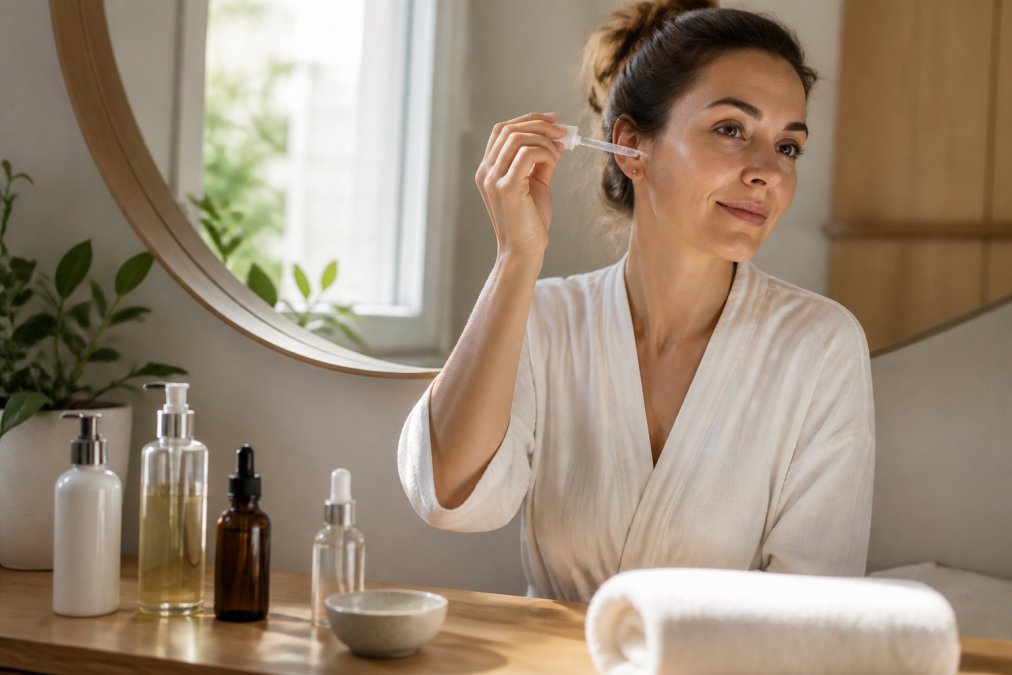
Morning:
- Gentle cleanser
- Vitamin C serum
- Hyaluronic acid serum
- Moisturizer
- Broad-spectrum sunscreen, SPF 30+
Night:
- Gentle cleanser
- Retinol serum (start twice weekly)
- Moisturizer or facial oil
Retinol for Beginners Guide: How to Start Without Irritation
Start retinol twice per week at night and build to every other night over four to six weeks. This retinol for beginners approach prevents the peeling and redness that makes people quit.
- Week 1-2: Twice weekly
- Week 3-4: Every other night
- Week 5+: Nightly, if your skin tolerates it
SPF and Sun Protection: The Non-Negotiable Step
Sunscreen is the single most effective anti-aging step and the one beginners skip most. Daily broad-spectrum SPF 30+ prevents photoaging, UV-driven collagen breakdown responsible for most visible fine lines, wrinkles, and age spots.
Sensitive Skin, Purging, and Patch Testing Protocols
Sensitive skin needs a plan, not just caution. Beginners often abandon anti-aging actives because they can't tell a normal adjustment period from a genuine reaction. This section covers patch testing, purging versus irritation, and a concrete retinization schedule.
Patch Testing Before You Commit
Patch testing checks whether your skin will react before you apply a product to your whole face. Apply a small amount behind your ear or on your inner forearm, wait 24 to 48 hours, and check for redness, itching, or swelling. If nothing happens, test again on a small jawline patch for 24 hours before going full-face. This catches most contact reactions without a week of visible irritation.
Purging vs. Irritation: How to Tell Them Apart
Purging and irritation look similar at a glance but behave differently, and the distinction determines whether you push through or stop.
- Purging happens because retinol and exfoliating acids speed up cell turnover, pushing existing clogs to the surface faster. It shows up as small breakouts in the areas where you normally break out, and it fades within roughly two to four weeks as turnover stabilizes.
- Irritation is damage to the skin barrier, not accelerated turnover. It shows up as burning, stinging, peeling, or redness across the whole face, including areas that never break out. It does not resolve on its own and usually gets worse with continued use.
A Retinization Schedule You Can Actually Follow
Retinization is the adjustment period your skin goes through when you introduce a retinoid. A slow ramp works better than pushing through discomfort. A common schedule:
- Weeks 1-2: Apply retinol twice weekly, on non-consecutive nights.
- Weeks 3-4: Move to every other night if there's no burning or widespread redness.
- Weeks 5-6: Try three nights in a row, then a night off, if your skin tolerates it.
- Week 7 and beyond: Move to nightly use only if your skin stays calm. There is no prize for rushing this.
Supporting a Reactive Barrier
When your barrier is compromised, everything stings. Cut back to a gentle cleanser, a basic moisturizer, and sunscreen until skin feels normal. Ceramides, squalane, panthenol, and colloidal oatmeal support barrier repair, keep them on hand for recovery nights.
Lifestyle Habits That Support Your Anti Aging Routine
No serum outruns poor sleep, dehydration, and daily sun damage. Internal factors shape skin as much as any topical, and beginners often ignore them.
Frequently Asked Questions
What is the best age to start an anti aging routine?
Most dermatologists suggest starting in your mid-20s to early 30s, when collagen production begins to slow and fine lines first appear. That said, any age is a good time to begin. A simple anti aging routine with a gentle cleanser, moisturizer, and broad-spectrum sunscreen is enough for beginners. Add retinol or vitamin C once your skin is used to the basics.
How long does it take to see results from an anti aging routine?
Hydration and glow can improve within a week or two. Fine lines, skin texture, and hyperpigmentation typically take 8 to 12 weeks of consistent use before you notice real change. Retinol and glycolic acid work gradually by supporting cell turnover and collagen production, so give any new routine at least three months before judging results.
What is the difference between retinol and glycolic acid in anti-aging?
Retinol speeds up cell turnover and supports collagen production, which helps with fine lines, wrinkles, and skin elasticity. Glycolic acid is an exfoliant that dissolves dead surface cells, improving skin texture, dullness, and hyperpigmentation. Many beginners use retinol at night and glycolic acid a few times a week, but never on the same evening at first to avoid irritation.
How do I layer skincare products for maximum effectiveness?
Apply products from thinnest to thickest. After cleansing, use a serum like vitamin C or hyaluronic acid, then a treatment such as retinol, and finish with a moisturizer to seal everything in. In the morning, always end with broad-spectrum sunscreen. Wait about 30 seconds between layers so each product absorbs before the next one goes on.
Can a simple skincare routine really prevent signs of aging?
Yes. Daily broad-spectrum sunscreen is the single most effective step for preventing photoaging, which causes most visible wrinkles and age spots. Pairing SPF with a gentle cleanser, moisturizer, and one active ingredient like retinol gives you a solid anti aging routine. Consistency matters more than the number of products you use.
What are the most important anti-aging ingredients for beginners?
Start with four: broad-spectrum sunscreen (SPF 30+), retinol, vitamin C, and hyaluronic acid. Sunscreen prevents damage, retinol supports collagen production and cell turnover, vitamin C provides antioxidant protection and brightens skin, and hyaluronic acid delivers deep hydration. Ceramides and niacinamide are also gentle options that support the skin barrier while you build tolerance.
Building an anti aging routine that actually lasts comes down to three steps done daily, one active introduced at a time, and sunscreen you never skip. EVERGRENE curates serums built for exactly this: a retinol and collagen formula that hydrates while it renews, a hyaluronic acid serum for barrier support, and a glycolic acid exfoliant for texture. Get started with EVERGRENE and build a routine simple enough to keep.