
Gloskinbeauty vs Skinbeautysolutions for Aging
Table of Contents
- Quick Comparison: Gloskinbeauty vs Skinbeautysolutions for Aging
- Ingredient Showdown: What Actually Works for Aging Skin
- Best Medical Grade Skincare for Aging: Evaluating the Options
- Retinol Alternatives for Aging Skin: What to Try When Retinol Irritates
- How to Choose Anti-Aging Serums: A Practical Framework
- Skin Type Compatibility: Which Line Suits Your Skin
- Frequently Asked Questions
Last Updated: September 10, 2026
Quick Comparison: Gloskinbeauty vs Skinbeautysolutions for Aging
Comparing gloskinbeauty vs skinbeautysolutions for aging, you'll notice both brands talk a good game about retinol and peptides. Neither publishes full ingredient concentrations on the front of the box, and that's where the real story lives. Brands that win on aging skin tell you what's inside, at what strength, and why it matters for your barrier. Here's what separates the two approaches, and how to build a routine that delivers results without irritation.
Winner: Neither, for most people. Both lines rely on vague "medical-grade" positioning without transparent concentrations. A serum that lists its retinol percentage and pairs it with barrier-supporting ingredients will outperform a prettier bottle every time.
| Factor | Gloskinbeauty | Skinbeautysolutions | What to Look For Instead |
|---|---|---|---|
| Ingredient transparency | Partial | Partial | Full INCI list with percentages |
| Retinol format | Unclear | Unclear | Encapsulated or plant-based retinol |
| Barrier support | Limited info | Limited info | Ceramides, squalane, glycerin |
| Cost per use | Higher per mL | Mid-range per mL | Under $2 per application |
| Best for | Marketing-led buyers | Routine-led buyers | Ingredient-led buyers |
Ingredient Showdown: What Actually Works for Aging Skin
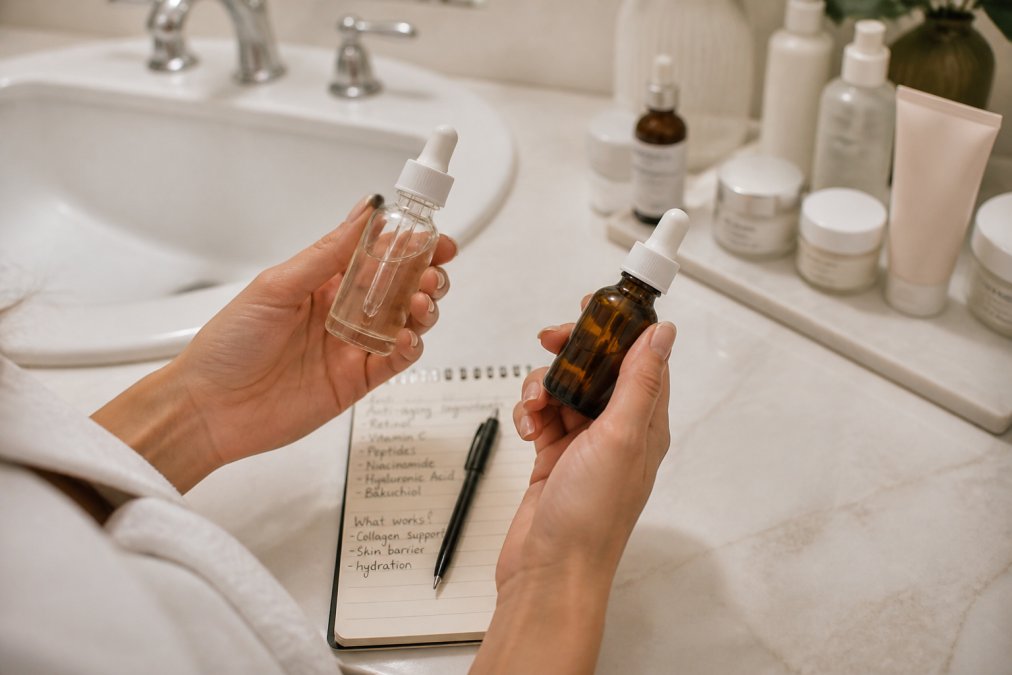
Aging skin responds to a short list of proven actives: retinoids, peptides, antioxidants, and humectants. Everything else is supporting cast. Comparing gloskinbeauty vs skinbeautysolutions for aging, the question isn't which brand sounds more clinical, it's which delivers these four categories in absorbable forms, at what concentration.
Most brand-versus-brand articles stop at "both use retinol and peptides." That's a press release, not a comparison. The useful comparison is mechanism-by-mechanism: what form of each active is used, how it's delivered, and what that means for a 45-, 55-, or 65-year-old barrier that's thinner, drier, and slower to turn over.
Retinol and Peptides: Concentration and Delivery
Retinol is the most studied anti-aging ingredient available without a prescription, according to the American Academy of Dermatology's guidance on retinoids. But concentration and delivery format matter as much as the ingredient name. Encapsulated retinol releases slowly, which reduces irritation while still supporting collagen production over time. Plant-based retinol alternatives, including bakuchiol, offer a gentler path for sensitive skin.
The mechanism separates a retinol that works from one that just stings. Free (unencapsulated) retinol hits the skin all at once, which is why so many people quit in week two with peeling and redness. Encapsulated retinol is wrapped in a lipid or polymer shell that dissolves over hours, delivering a lower, steadier dose, often the difference between sticking with a routine and abandoning it.
Peptides work on a different clock. A multi-peptide complex signals the skin to rebuild its support structure, and the effect compounds with consistent use. Look for peptides listed near the top of the ingredient deck, not buried after fragrance. A peptide listed after the preservative is decorative, not functional.
Read the two lines side by side and the pattern is clear: a brand listing "retinol" with no format or percentage asks you to trust the marketing, while one listing "encapsulated retinol" or "bakuchiol" tells you what your skin will experience. Neither publishes full percentages on the front of the box, the biggest reason this comparison is harder than it should be.
Antioxidants and Hydration: Beyond the Hype
Antioxidant-rich formulas defend against environmental stress that accelerates fine lines and uneven tone; resveratrol, vitamin C, and vitamin E are the workhorses. Hydration is equally non-negotiable: hyaluronic acid and glycerin pull water in, while squalane and ceramides seal it in and reinforce the barrier. A serum that hydrates without barrier support leaves skin vulnerable; one that supports the barrier without actives does nothing for wrinkles. You need both.

Hyaluronic acid is a humectant that binds water and pulls it into the upper layers. Squalane is an emollient that mimics the skin's own sebum and slows water loss. Ceramides are the mortar between skin cells; when depleted by age or over-exfoliation, the barrier leaks moisture and lets irritants in. A serum pairing a humectant, an emollient, and a ceramide does three jobs at once; one listing only hyaluronic acid does one.
Vitamin C is the most formulation-sensitive antioxidant on the list. It oxidizes quickly, which is why it's sold in opaque, airless packaging. A vitamin C serum in a clear dropper bottle is losing potency before you finish it, a format signal you can read without lab testing.
The Format Checklist for Mature Skin
When you're holding two bottles and trying to decide, run this quick read on the label:
- Retinol format: encapsulated, buffered, or plant-based, not just "retinol."
- Peptide position: in the top third of the ingredient list, not after fragrance.
- Barrier trio: at least one humectant (hyaluronic acid, glycerin), one emollient (squalane), and ideally one ceramide.
- Antioxidant packaging: opaque or airless if vitamin C is present.
- Full INCI list: published on the brand site, not just "key ingredients."
Best Medical Grade Skincare for Aging: Evaluating the Options
The best medical-grade skincare for aging discloses its active concentrations and pairs them with barrier-supporting ingredients. "Medical-grade" is a marketing term, not a regulatory one, so it tells you nothing on its own. What tells you something is a label reading "0.3% encapsulated retinol" or "5% glycolic acid" alongside squalane and glycerin.
When evaluating any line, including gloskinbeauty vs skinbeautysolutions for aging, run this checklist:
- Are active ingredients listed with percentages?
- Does the formula include at least one barrier ingredient (squalane, ceramides, glycerin)?
- Is the retinol encapsulated or buffered for sensitive skin?
- Is the product dermatologist-tested and paraben-free?
- Does the brand publish a full ingredient list, not just "key ingredients"?
Retinol Alternatives for Aging Skin: What to Try When Retinol Irritates
Retinol alternatives for aging skin include bakuchiol, glycolic acid, and peptide-forward serums that build collagen support without the peeling and redness standard retinol can cause. If traditional retinol leaves your skin tight, flaky, or stinging, you don't have to abandon anti-aging actives. You switch formats.
Most articles list the alternatives and stop there. The gap they miss is the decision layer: which alternative fits which skin, in what order, and how it slots into your routine. That's what determines whether you see results or just collect bottles.
Matching the Alternative to the Problem
Glycolic acid is the strongest alternative for texture and uneven tone (peer-reviewed research). This alpha-hydroxy acid loosens the bonds between dead surface cells so they shed instead of piling up, smoothing fine lines over time. Pair it with a hydrating serum to avoid the raw feeling. The trade-off: it increases sun sensitivity, so daily broad-spectrum sunscreen is non-negotiable.
Peptide serums work on a slower timeline but carry almost no irritation risk, making them solid for mature skin that has thinned over the years. They don't exfoliate or accelerate turnover, they signal the skin to build more of its own support structure. That's a different job than retinol does, and for very thin or reactive skin, often the more appropriate one.
Bakuchiol is the plant-based retinol alternative that gets the most attention. It appears to influence some of the same collagen pathways as retinol without the receptor binding that causes the classic reaction (PubMed). The honest framing: it's gentler, and gentler usually means slower. For minimizing irritation, bakuchiol is a reasonable first step; for maximum collagen response in the shortest time, retinol still leads.
A Sequencing Framework for Sensitive Mature Skin
The mistake most people make is stacking alternatives, glycolic acid Monday, bakuchiol Tuesday, peptides every night. That's not a gentle routine, it's an irritated one. The framework that works is one active at a time, introduced over weeks:
- Weeks 1-4: Barrier first. A hydrating serum with hyaluronic acid and squalane, nothing exfoliating.
- Weeks 5-8: Add a peptide serum at night. If your skin stays calm, keep it.
- Weeks 9-12: If you want more, introduce either glycolic acid (two nights a week) or bakuchiol (most nights), not both.
- Ongoing: Once your skin tolerates the routine, you can consider a low-strength encapsulated retinol in place of the alternative.
This sequence separates a routine that compounds from one that stalls, each step tests your barrier before adding load.
How This Applies to the Two Lines
Comparing gloskinbeauty vs skinbeautysolutions for aging through this lens, the useful question isn't "does the brand offer a retinol alternative?" Almost every line does. It's whether the alternative is formulated with barrier support built in, or is a standalone active that leaves your skin needing a second product to recover.
A bakuchiol serum with squalane and glycerin can be a one-step night routine for sensitive skin; without them it's a half-finished product. Same ingredient, very different experience. Read the deck, not the front of the bottle.
The trade-off across all three alternatives is speed: glycolic acid and peptides deliver results over weeks, not days. That's the honest cost of avoiding irritation, and for thin, reactive, mature skin, usually worth paying.

How to Choose Anti-Aging Serums: A Practical Framework
Choosing an anti-aging serum comes down to three questions: what active does your skin need, what concentration can it tolerate, and what does each application cost? Answer those in order and the brand question mostly resolves itself. Most people get this backwards, starting with the label and working toward their skin. Reverse it.
Start with your primary concern. Fine lines and wrinkles point to retinol or peptides; uneven tone and texture point to glycolic acid; dryness and a compromised barrier point to hyaluronic acid and squalane first, actives second. Then match concentration to tolerance: sensitive skin starts with plant-based retinol or peptides, resilient skin with encapsulated retinol.
Cost-Per-Use Analysis: The Hidden Price of Serums
Cost per use is the number that actually matters, and almost nobody calculates it. A 30 mL serum applied at 2-3 drops per use lasts roughly 60 to 90 applications; divide the price by that range for your real cost per application.
This is where the gloskinbeauty vs skinbeautysolutions for aging comparison gets uncomfortable for both brands. A $50 serum lasting 60 uses costs about $0.83 per application; a $30 serum lasting 30 uses costs $1.00. The cheaper bottle is the more expensive habit. EVERGRENE's Collagen and Retinol Serum at $49.80 combines collagen, retinol, and hyaluronic acid in one 30 mL bottle, so you're not buying three products to cover the same ground.
Skin Type Compatibility: Which Line Suits Your Skin
Skin type compatibility decides more outcomes than brand loyalty ever will. Dry and mature skin needs humectants and emollients first: hyaluronic acid, glycerin, and squalane. Oily and combination skin does better with lightweight, water-based serums and glycolic acid for texture. Sensitive skin should skip high-concentration retinol and start with peptides or plant-based alternatives.
| Skin Type | Primary Need | Best Active | Avoid |
|---|---|---|---|
| Dry / mature | Barrier repair, hydration | Hyaluronic acid, squalane | High-strength retinol |
| Oily / combination | Texture, oil balance | Glycolic acid | Heavy oils |
| Sensitive | Gentle renewal | Peptides, plant-based retinol | Fragrance-heavy formulas |
| Normal | Maintenance | Antioxidants, peptides | Over-exfoliation |
EVERGRENE's Age Defying Serum at $55.00 leans on squalane, glycerin, and hydrolyzed soy protein, suiting dry and mature skin without the irritation risk of a strong retinol. For oily skin, the Glycolic Acid Serum at $46.70 handles texture and uneven tone with vitamin E and squalane to keep the barrier intact.

The comparison between gloskinbeauty vs skinbeautysolutions for aging ultimately matters less than what's inside the bottle. Both lines leave gaps in transparency that make real evaluation difficult, and neither gives you a clear cost-per-use picture. EVERGRENE takes a different approach: serums with disclosed ingredients, barrier support built in, and pricing that holds up when you do the per-application math. Start with the Collagen and Retinol Serum for firmness and hydration, or the Hyaluronic Acid Serum at $34.00 if your barrier needs rebuilding first. Get started with EVERGRENE and build a routine that delivers results you can actually measure.
Frequently Asked Questions
What is the most effective skin care brand for aging skin?
There is no single best brand. Look for products with proven ingredients like retinol, hyaluronic acid, and antioxidants. Medical-grade lines often have higher active concentrations, but what matters is formulation and your skin's tolerance. EVERGRENE offers a Collagen and Retinol Serum ($49.80) that combines retinol with hydrating hyaluronic acid, which can be a good starting point for aging skin. Always check ingredient lists and reviews before committing to a full routine.
Is Glo Skin Beauty considered medical-grade skincare?
Glo Skin Beauty is often described as clinical or professional-grade, but the term 'medical-grade' is not regulated. Their products are used in spas and dermatology offices, and they focus on active ingredients. However, medical-grade typically implies higher concentrations available only through physicians. For aging skin, what matters more is whether the product contains effective actives like retinol or vitamin C at concentrations your skin can tolerate. Compare formulations rather than labels.
What ingredients should I look for in anti-aging skincare?
Prioritize retinol or its alternatives (like peptides or plant-based retinol), hyaluronic acid for hydration, vitamin C for brightening, and antioxidants such as resveratrol. For fine lines and wrinkles, retinoids are the most studied. If your skin is sensitive, try a gentler alternative like the Age Defying Serum ($55.00) which uses squalane and hydrolyzed soy protein to improve elasticity without irritation. Always introduce one active at a time.
How do professional skincare lines differ from drugstore brands?
Professional lines often use higher concentrations of active ingredients and more sophisticated delivery systems, which can improve bioavailability. Drugstore brands may use lower concentrations to suit a wider audience. However, price does not always equal efficacy. Some drugstore products contain effective ingredients like retinol or niacinamide. The key difference is often in formulation standards and clinical testing. Look for brands that disclose ingredient percentages and have dermatologist-tested claims.
Can mineral makeup from Glo Skin Beauty benefit aging skin?
Mineral makeup can be beneficial for aging skin because it often lacks irritants like fragrances and parabens, and provides sun protection if it contains zinc oxide or titanium dioxide. For aging skin, the main benefit is avoiding heavy formulas that settle into fine lines. However, makeup alone won't treat aging. Pair it with a restorative skincare routine that includes hydration and collagen support, such as a serum with hyaluronic acid, to see real improvements in skin texture.