
How to Fix Dull Dehydrated Skin: A 2026 Guide
Table of Contents
- Dry vs Dehydrated Skin: Why the Difference Matters
- What Causes Dull Dehydrated Skin
- Best Ingredients for Dehydrated Skin
- Skincare Routine for Dull Skin: Step-by-Step
- Internal Hydration vs Topical Hydration
- How Long It Takes to Fix Dehydrated Skin: Recovery Timeline
- Common Mistakes That Keep Dehydrated Skin Dull
- Conclusion
Last Updated: August 23, 2026
Dull, tight, flat-looking skin is one of the most common complaints dermatologists and estheticians hear, and the fix most people reach for is the wrong one. People often treat dehydrated skin like dry skin, layer on heavy oils and creams, and wonder why their complexion still looks lackluster two weeks later. The root issue is a loss of water content in the epidermis, not a lack of oil, and that distinction changes everything about how you treat it.
This guide covers how to fix dull dehydrated skin from the inside out: the right ingredients, a practical step-by-step routine, and a realistic timeline for recovery.
Dry vs Dehydrated Skin: Why the Difference Matters
Dry skin is a skin type, a genetic tendency to produce less sebum. Dehydrated skin is a temporary condition, a deficit of water in the skin's upper layers that can affect any skin type, including oily skin.
If you treat dehydration with heavy occlusive creams designed for dry skin, you may seal moisture in temporarily, but you're not addressing the underlying cause: transepidermal water loss (TEWL). TEWL is the process by which water evaporates through the skin barrier into the surrounding air. When the lipid barrier is compromised, TEWL accelerates, and skin loses hydration faster than it can retain it.
Signs of dehydrated skin include:
- Tightness, especially after cleansing
- Dullness and a flat, uneven complexion
- Fine lines that appear more pronounced when the skin is pinched
- A feeling of sensitivity or irritation without visible redness
- Flakiness that coexists with oiliness
How to Test for Dehydrated Skin at Home
The pinch test is the most practical at-home check. Gently pinch a small section of skin on your cheek between two fingers and hold for a few seconds. If the skin snaps back immediately, hydration levels are healthy. If it takes a moment to flatten, or if you can see fine lines form in the pinched area, the skin is likely dehydrated.
Look at your skin in bright natural light after cleansing and before applying any products. Dehydrated skin often appears dull and slightly gray or uneven in tone. If your skin looks flat but feels oily, dehydration is almost certainly the issue.
What Causes Dull Dehydrated Skin
Most people attribute dehydrated skin to not drinking enough water. That's a factor, but it's rarely the whole story. The real cause is usually a compromised skin barrier combined with external stressors that accelerate TEWL. You can drink two liters of water a day and still have dehydrated skin if your barrier is damaged.
Common causes include:
- Over-exfoliation: Stripping the epidermis too frequently disrupts the acid mantle and lipid barrier
- Harsh surfactants in cleansers: Foaming cleansers with sulfates are a frequent culprit
- Retinoids and glycolic acid without proper support: These actives increase cell turnover and can elevate TEWL if not paired with barrier-supporting ingredients
- Low-humidity environments: Air conditioning and central heating both reduce ambient moisture
- Hot showers: Heat disrupts the skin's natural pH balance and lipid structure
Environmental Triggers Beyond Weather
Air conditioning removes humidity from enclosed spaces year-round. Office environments, airplane cabins, and heated cars all create low-humidity conditions that pull moisture from the skin's surface continuously. According to the American Academy of Dermatology's guidance on skin and environment, indoor heating can drop relative humidity to levels that significantly accelerate TEWL.
Blue light exposure from screens and pollution are emerging concerns. Particulate matter weakens the skin barrier and increases sensitivity. Fixing dehydrated skin requires addressing your indoor environment, not just your product shelf.
Best Ingredients for Dehydrated Skin
The right ingredients for dehydrated skin fall into three functional categories: humectants that attract water, occlusives that prevent its escape, and barrier-repair ingredients that fix the underlying structural problem.
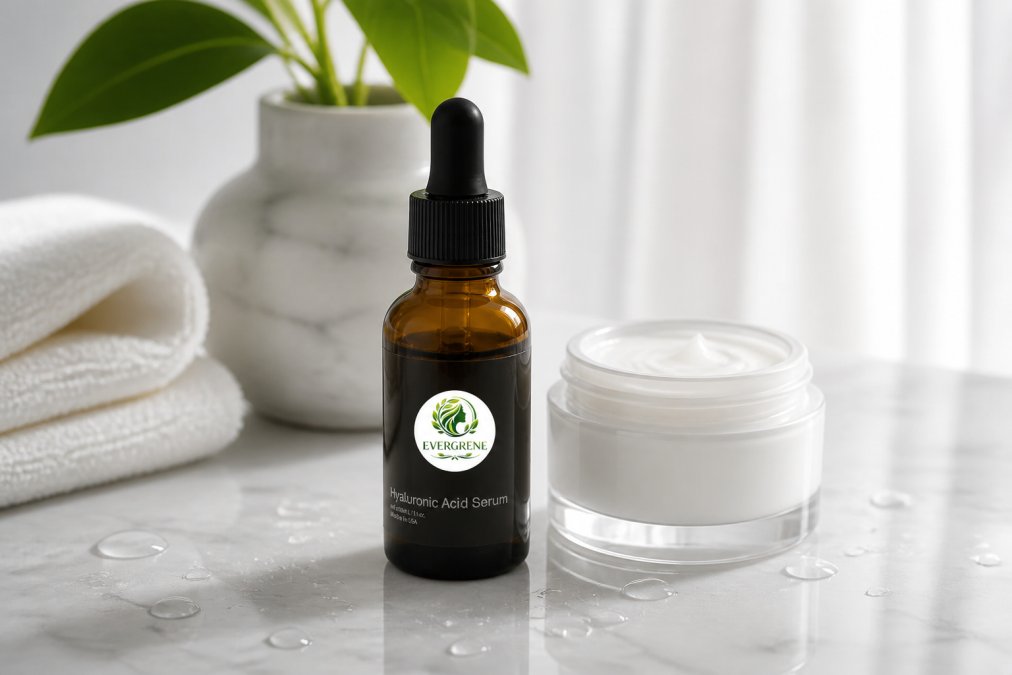
Humectants: Hyaluronic Acid and Glycerin
Humectants are water-binding molecules that draw moisture from the environment and deeper skin layers into the epidermis. Hyaluronic acid is the most well-known: a single molecule can hold many times its weight in water. For best results, apply hyaluronic acid to damp skin before sealing with a moisturizer; applying it to dry skin in a low-humidity environment can actually pull moisture out of the dermis instead.
Glycerin is equally effective and often underrated. As documented in the National Institutes of Health's review of skin moisturization ingredients, glycerin is one of the most studied and consistently effective humectants in dermatological formulations.
The EVERGRENE Hyaluronic Acid Serum combines both ingredients in a single formulation. Applied to damp skin as the first serum step, it addresses water loss at the surface while supporting skin plumpness and elasticity.

Occlusives and Ceramides for Barrier Support
Humectants attract water; occlusives lock it in. Without an occlusive layer, the water a humectant draws in evaporates within hours. The most dermatologically significant barrier-repair ingredients are ceramides, lipid molecules that make up a significant portion of the skin's natural barrier structure. When ceramide levels drop through age, over-exfoliation, or environmental stress, the lipid barrier becomes porous and TEWL increases.
Look for moisturizers that combine ceramides with fatty acids and cholesterol, which is the ratio that most closely mirrors the skin's natural lipid composition. Non-comedogenic formulas are important: barrier repair doesn't require pore-clogging ingredients.
The EVERGRENE Hyaluronic Moisturizer pairs hyaluronic acid with tamarindus indica seed gum, a plant-based alternative that provides comparable hydration and plumping effects without synthetic additives.

Skincare Routine for Dull Skin: Step-by-Step
A structured routine is the most reliable way to address dehydrated skin. The goal is a layering system that attracts water, binds it, and seals it in, while protecting the barrier from further damage.
| Step | Product Type | Purpose | When |
|---|---|---|---|
| 1. Cleanse | Gentle, low-pH cleanser | Remove impurities without stripping | AM + PM |
| 2. Hydrating serum | Hyaluronic acid + glycerin | Draw water into epidermis | AM + PM |
| 3. Moisturizer | Ceramide-based or occlusive | Seal in hydration, repair barrier | AM + PM |
| 4. SPF | Broad-spectrum SPF 30+ | Block UV-driven TEWL and oxidative stress | AM only |
| 5. Exfoliation | Chemical exfoliant | Remove dead cell buildup causing dullness | 2-3x per week PM |
Morning Routine
Start with a gentle, low-pH cleanser. Foaming cleansers with sulfates are a common cause of dehydration; switch to a cream or gel formula that preserves the skin's acid mantle.
Apply your hyaluronic acid serum immediately while skin is still damp. Follow with your moisturizer to seal the humectant layer. Finish with a broad-spectrum SPF 30 or higher. UV exposure is one of the primary drivers of barrier degradation, and skipping sunscreen daily undoes most of the repair work you do at night.
Evening Routine
- Double-cleanse if you wear SPF or makeup: oil cleanser first, then your gentle cleanser
- Apply hyaluronic acid serum to damp skin
- If using retinoids or glycolic acid, apply after the serum step, never on bare, dry skin
- Seal with your ceramide moisturizer or a dedicated overnight barrier cream
- For very compromised skin, apply a thin layer of occlusive over the moisturizer
Internal Hydration vs Topical Hydration
Topical products address the skin's surface, but water content in the dermis is also influenced by systemic hydration. The dermis, the deeper layer of skin beneath the epidermis, contains a matrix of collagen and water. When systemic hydration is consistently low, the dermis loses some of its natural plumpness and skin elasticity declines.
Practical internal hydration habits that support skin health:
- Consistent water intake throughout the day
- Reducing alcohol and caffeine, both of which have diuretic effects
- Eating foods high in water content: cucumber, watermelon, leafy greens
- Omega-3 fatty acids from fish, flaxseed, or walnuts, which support the lipid barrier from within
Internal hydration alone won't fix a damaged skin barrier, but it creates the conditions where topical products can actually work. According to Harvard T.H. Chan School of Public Health's guidance on water and health, adequate hydration supports numerous cellular functions, including those that affect skin cell turnover and repair.
How Long It Takes to Fix Dehydrated Skin: Recovery Timeline
Days 1-3: With the right routine, skin tightness and discomfort typically ease within the first few days. The skin barrier responds relatively quickly to humectants and occlusives.
Week 1-2: Dullness starts to lift as surface hydration improves and dead cell buildup reduces. Skin texture becomes smoother and complexion looks more even.
Week 3-4: Barrier function begins to strengthen if ceramide-rich products are used consistently. Fine lines caused by dehydration become less visible.
Month 2-3: Full barrier recovery and sustained improvement in skin plumpness and elasticity.
If you continue the habits that caused dehydration, over-exfoliating, using harsh cleansers, skipping SPF, recovery stalls regardless of how many serums you apply. Fixing dehydrated skin is as much about removing the wrong things as adding the right ones.
Common Mistakes That Keep Dehydrated Skin Dull
1. Using too many actives at once. Retinoids, glycolic acid, salicylic acid, and vitamin C are all effective, but layering multiple exfoliating actives simultaneously overwhelms the skin's repair capacity and elevates TEWL. Introduce actives one at a time and build tolerance slowly.
2. Skipping moisturizer because skin feels oily. Oily and dehydrated skin coexist frequently. The skin often overproduces sebum to compensate for water loss. A lightweight, oil-free moisturizer is non-negotiable even for oily skin types. The EVERGRENE Oil-Free Daily Moisturizer is formulated specifically for this: it delivers fatty acids and moisture without a heavy finish.

3. Exfoliating too often. Physical and chemical exfoliation address dullness caused by dead cell buildup, but daily exfoliation prevents the skin barrier from repairing between sessions. Two to three times per week is the ceiling for most skin types. The EVERGRENE Mint Exfoliating Facial Polish uses a blend of lemon, apple, aloe vera, and apricot oil to buff away dullness while maintaining moisture.
4. Applying serums to dry skin. Hyaluronic acid needs moisture to bind to. Applied to completely dry skin in a low-humidity environment, it can pull water upward from the dermis, temporarily worsening surface dehydration. Always apply on damp skin.
5. Treating the symptom without addressing the cause. If your cleanser is stripping your barrier every morning, no amount of serum will keep up. Audit the products that come before your actives, not just the actives themselves.
As noted in the American Academy of Dermatology's recommendations on moisturizers and barrier repair, consistent use of barrier-supportive moisturizers is one of the most evidence-backed approaches to improving skin hydration over time.
Persistent dehydrated skin is frustrating precisely because the fixes seem obvious but don't stick. The barrier damage that causes it builds up over months of small habits, the wrong cleanser, too many actives, skipped SPF, and it takes a structured, consistent approach to reverse. EVERGRENE's hydration range is built around this reality: formulations that combine hyaluronic acid, glycerin, and barrier-supportive ingredients in products designed to work together without overwhelming your routine. Start with the Hyaluronic Acid Serum and Oil-Free Daily Moisturizer as your foundation, and let the barrier rebuild before reintroducing stronger actives.
Frequently Asked Questions
Q: Does dehydrated skin look dull?
A: Yes. When your skin lacks sufficient water content, light reflects unevenly off the surface, which creates a flat, lackluster complexion. Dehydration also makes fine lines more visible and can cause a rough skin texture that dulls your natural glow. Restoring hydration levels with the right humectants and occlusives typically brings back plumpness and radiance within a few weeks of consistent use.
Q: How can I tell if my skin is dry or dehydrated?
A: Dry skin is a skin type caused by low oil production, so it feels rough year-round regardless of products used. Dehydrated skin is a condition caused by a lack of water, and it can affect oily, combination, or normal skin types too. A quick pinch test helps: gently pinch a small area of your cheek. If the skin snaps back slowly or shows fine creases, dehydration is likely. Dry skin will feel consistently flaky and tight no matter your water intake.
Q: Is dehydrated skin reversible?
A: Dehydrated skin is fully reversible with the right approach. Unlike a permanent skin type, dehydration is a temporary condition triggered by lifestyle habits, environmental stressors, or product choices. Most people see noticeable improvement in skin texture and plumpness within one to two weeks of adding a hyaluronic acid serum and a barrier-supporting moisturizer. Full recovery, including reduced dullness and improved skin elasticity, typically takes four to six weeks.
Q: What ingredients should I avoid if my skin is dehydrated?
A: Avoid harsh sulfate-based cleansers that strip the lipid barrier and raise skin pH, which increases transepidermal water loss. Alcohol-heavy toners and astringents remove surface oils that help seal in moisture. Over-exfoliating with strong acids or physical scrubs too frequently can also damage the epidermis before it has time to repair. Limit these until your skin barrier is restored, then reintroduce active ingredients like retinoids gradually.
This article was written using GrandRanker