
Simple Skincare Routine Cost Comparison
Table of Contents
- Understanding Skincare Routine Cost Hierarchy
- The Three-Step Foundation and What It Costs
- How to Fix Dull Dehydrated Skin Without Breaking the Bank
- Is Luxury Skincare Worth the Price? A Cost-Per-Use Analysis
- Building an Affordable Skincare Routine for Beginners
- Multi-Use Products and Subscription Models That Lower Your Monthly Spend
- When to Splurge and When to Save on Skincare
- Frequently Asked Questions
Last Updated: September 28, 2026
Understanding Skincare Routine Cost Hierarchy
Most people overspend on products they don't need. Understanding which steps are essential versus luxury additions is key. Understanding which steps are essential versus luxury additions is key.
Foundation products, cleanser, moisturizer, and sunscreen, are non-negotiable. Everything else builds on that base. The real problem is choosing between products that address your actual needs versus products that promise results you don't need yet.
Cost doesn't correlate with results. A $15 cleanser and a $150 cleanser both remove dirt equally. The difference lies in active ingredients and whether the product targets a specific concern you have. A skincare routine cost comparison forces you to separate marketing from substance.
The Three-Step Foundation and What It Costs
EVERGRENE's Oil-Free Daily Moisturizer at $45 per bottle lasts 6-8 weeks, costing roughly $24-28 monthly.

Anything beyond this addresses a specific concern: dullness, dehydration, fine lines, or texture.
Most people skip the foundation or use inconsistent products, then buy serums that don't work. A consistent three-step routine beats an expensive nine-step routine with gaps in the basics.
How to Fix Dull Dehydrated Skin Without Breaking the Bank
Dull, dehydrated skin often signals a weak foundation. Verify your cleanser and moisturizer are hydrating before adding products. If dullness persists, a hydrating serum bridges the gap affordably.
EVERGRENE's Hyaluronic Acid Serum at $34 addresses dehydration. Applied after cleansing, it layers hydration without grease. A 1 fl. oz. bottle lasts 8-12 weeks, costing roughly $11-17 monthly.

For dullness, chemical exfoliation works better. EVERGRENE's Glycolic Acid Serum at $46.70 evens hyperpigmentation and brightens complexion. Used 2-3 times weekly, it costs about $12-15 monthly.

Strengthen your foundation first, add a hydrating serum, then introduce exfoliation. This three-product stack addresses the root cause.
Is Luxury Skincare Worth the Price? A Cost-Per-Use Analysis
Cost-per-use analysis reveals whether a premium product saves money over time or simply feels luxurious.
How to calculate cost-per-use: Divide product price by applications. A serum used twice daily has roughly 60 applications per month; a moisturizer used once daily has roughly 30.
Example: A $40 serum used twice daily costs $0.67 per application; a $120 serum costs $2 per application. If both deliver identical results, the $40 option wins.
But efficacy matters. If the $120 serum contains active ingredients the $40 version lacks, retinol, peptides, niacinamide at therapeutic concentrations, the cost-per-use calculation shifts. A retinol serum reducing fine lines in 8 weeks may justify $2 per application.
Real-world cost-per-use comparisons by concern:
Hydration: If your skin is adequately hydrated with the basic moisturizer, the serum is waste. If dehydration persists after 6 weeks, the serum becomes cost-effective.
Fine lines and early aging: Retinol serum costs roughly $1.00-1.50 per application. Clinical studies show visible improvements in 8-12 weeks. For someone with fine lines, it's justified. For smooth skin, it's preventive spending with uncertain results.
Texture and dullness: Chemical exfoliant serum (used 2-3 times weekly) costs roughly $0.30-0.50 per application with results in 4-6 weeks. The cost-per-use is justified if dullness is your concern.
The longevity factor: A lightweight serum lasts longer than a rich cream because you use less per application. Always check size and expected duration before calculating cost-per-use.
When premium products fail the cost-per-use test:
- Buying a $100 serum for a problem you don't have
- Choosing premium for basic functions (a $60 cleanser versus $15 both remove dirt equally)
- Purchasing trendy ingredients that don't address your concern
- Selecting premium products you won't use consistently
When premium products pass the cost-per-use test:
- The product targets a confirmed concern with proven active ingredients
- You've tested a basic version and confirmed it doesn't work
- The premium product's longevity justifies upfront cost
The practical rule: Calculate cost-per-month, not cost-per-bottle. A $60 serum lasting 12 weeks costs $20/month; a $30 serum lasting 4 weeks costs $30/month. Most people fail by comparing upfront price instead of monthly spend.
Building an Affordable Skincare Routine for Beginners
Start with cleanser, moisturizer, sunscreen. This solves 80% of skin problems. Commit for 6-8 weeks before adding anything else. Most beginners add products too quickly, making it impossible to identify what works.
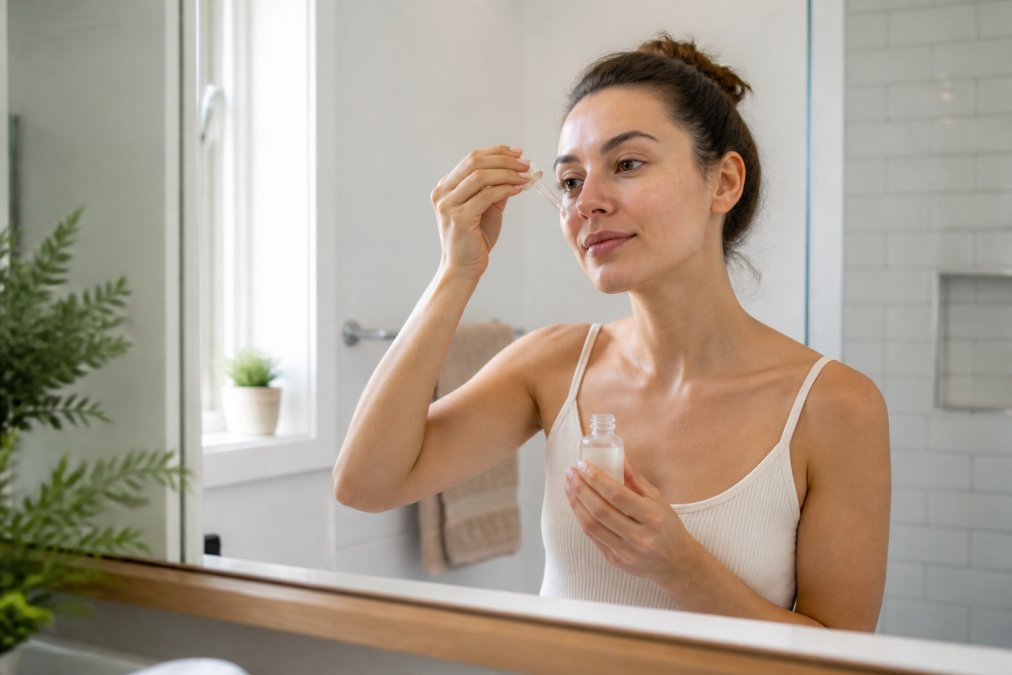
Once your foundation is consistent, identify your primary concern and address it with a single targeted product.
A beginner's affordable routine: cleanser ($15-25/month), moisturizer ($25-35/month), sunscreen ($15-25/month), one targeted serum ($12-18/month). Total: $67-103 monthly. Consistency beats complexity.
Multi-Use Products and Subscription Models That Lower Your Monthly Spend
Multi-use products and subscriptions promise savings, but only deliver if you understand when they reduce spending versus when they trap you in over-consumption.
How multi-use products lower costs: A moisturizer with SPF eliminates a separate sunscreen. A serum with multiple active ingredients addresses more concerns, reducing products needed. This consolidation lowers monthly spend.
Multi-use products only save money if the combined formula performs as well as separate products. Test for 4-6 weeks before committing; if you abandon them, you've wasted money.
How subscription models work: Most brands offer 10-20% discounts for auto-delivery. A $45 product might cost $36-40 per bottle, saving $20-50 annually per product.
Subscriptions encourage over-purchasing. A 15% discount on a product you use inconsistently is waste. Services often increase prices after the initial period or make cancellation difficult, trapping customers.
The subscription math that actually matters:
Calculate your true repurchase frequency before subscribing. If you use a moisturizer and a new bottle lasts 8 weeks, you repurchase 6-7 times per year. A 15% subscription discount saves roughly $27-35 annually on that single product. If you subscribe to three products, savings reach $80-105 per year, meaningful but not transformative.
The breakeven point: subscription only saves money if you're certain you'll repurchase the product at least 3-4 times per year. If you're still testing a product or your usage is inconsistent, the discount doesn't offset the risk of paying for unused inventory.
When subscription models trap you in waste:
- Automatic replenishment without usage tracking: You receive a new bottle before finishing the previous one, creating a stockpile. This is particularly common with serums, which are easy to over-order because they're small and feel inexpensive.
- Difficulty canceling: Some brands make unsubscribing complicated, requiring email requests or phone calls. This friction causes people to keep paying rather than go through the cancellation process.
- Price increases after the promotional period: A brand may offer 20% off for the first three months, then revert to full price or a smaller discount. By then, you're accustomed to the product and less likely to switch.
- Bundled subscriptions: Some services bundle multiple products together at a discount, encouraging you to buy items you don't need to reach a savings threshold.
The behavioral economics of subscriptions:
Subscription services exploit "sunk cost fallacy." Once you've committed to auto-delivery, you're more likely to use the product (even if it's not ideal) because you've already paid for it. This leads to over-consumption of products that don't work well for you, simply because they're convenient and already in your home.
How to use subscriptions strategically:
-
Only subscribe to products you've used for at least 8 weeks and confirmed you'll repurchase. This eliminates the risk of paying for products you abandon.
-
Set a calendar reminder for your subscription delivery date. Before the new shipment arrives, assess whether you've used the previous bottle. If you haven't, pause or cancel the subscription.
-
Calculate the annual savings and decide if it's worth the commitment. If a subscription saves you $30-50 per year on a single product, that's modest. If it saves $100+ annually across multiple products, it's worth the friction of managing subscriptions.
-
Avoid bundled subscriptions unless every product in the bundle is one you actively use. Bundling creates waste by forcing you to buy items you don't need to unlock the discount.
-
Check cancellation policies before subscribing. If canceling requires a phone call or takes more than two clicks online, the friction cost may outweigh the savings.
Multi-use products versus subscriptions: which saves more?
Multi-use products typically save more money than subscriptions because they reduce the number of items you purchase, not just the price per item.
When to Splurge and When to Save on Skincare
Splurge on products that directly contact your skin daily and address a specific concern you've confirmed you have. If you've used a basic moisturizer for 8 weeks and your skin is still dry, upgrading to a hydrating serum plus moisturizer makes sense. That's a splurge backed by evidence.
Frequently Asked Questions
What is the most affordable skincare routine that actually works?
A functional skincare routine for beginners starts with three essentials: a cleanser, moisturizer, and sunscreen. The Hyaluronic Acid Serum ($34) paired with the Oil-Free Daily Moisturizer ($45) delivers hydration and skin barrier support for under $80 total. Focus on active ingredients like hyaluronic acid and panthenol rather than brand names. Consistency matters more than complexity.
How much does a basic 3-step skincare routine cost per month?
The Collagen and Retinol Serum ($49.80) lasts 4-6 weeks when used nightly. Add a moisturizer at $45 per 1.5 oz (lasting 6-8 weeks) and you're at $27-$35 monthly.
Is expensive skincare actually better than affordable options?
Price doesn't guarantee results. Clinical efficacy depends on active ingredients, not cost. A $34 Hyaluronic Acid Serum with proven hydrating ingredients outperforms a $100 serum with weak formulations. What matters: ingredient concentration, skin type compatibility, and consistent use. Luxury products often charge for packaging and branding. Compare ingredient lists and cost-per-use rather than price tags alone. Many affordable products deliver identical active ingredients to premium brands.
What products should I prioritize if I have a tight skincare budget?
Prioritize in this order: cleanser, moisturizer, sunscreen (daily essentials), then targeted serums. The Oil-Free Daily Moisturizer ($45) handles hydration and barrier repair for sensitive skin. Add the Hyaluronic Acid Serum ($34) if dehydration is your main concern. Sunscreen is non-negotiable for preventative care. Only add exfoliants or specialty serums once basics are locked in and budget allows.
How long do skincare products last, and what's the real cost per use?
A 1 fl. oz serum (like the Glycolic Acid Serum at $46.70) lasts 4-6 weeks with 2-3 drops daily, bringing cost-per-use to roughly $0.30-$0.50 per application. A 1.5 fl. oz moisturizer ($45) lasts 6-8 weeks at $0.80-$1.07 per use. Calculate longevity by dividing product cost by estimated days of use. Products with higher active ingredient concentrations often cost more upfront but last longer, lowering per-use expense. This metric reveals true value better than sticker price alone.